
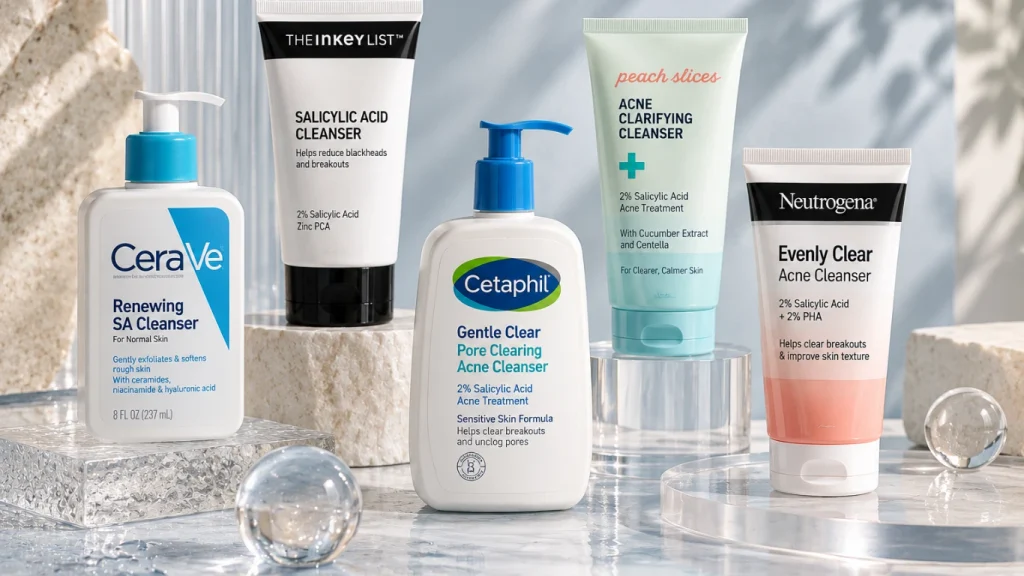
The best salicylic acid cleanser depends on your skin, and choosing one for blackheads shouldn’t feel like a chemistry exam. We like CeraVe Acne Control for very oily skin, Cetaphil Gentle Clear for sensitive skin and Peach Slices for dry skin. We matched six cleansers to six skin needs, so you can skip the guesswork.
Blackheads are a common worry, and the wrong cleanser can make them worse. A harsh wash dries out your skin, while a very mild one may not reach clogged pores. A good salicylic acid cleanser loosens the oil and dead skin inside the pore, then rinses off clean.
Below you will find the picks, how salicylic acid works, and how to use it without drying your face. Short on time? Start with the “at a glance” table.
Table of Contents
Best Salicylic Acid Cleansers at a Glance
| Cleanser | Best for | SA strength | Price | size |
| CeraVe Renewing SA Cleanser | Normal skin, beginners | Not disclosed | $15.97 | 16 fl oz |
| The INKEY List Salicylic Acid Cleanser | Oily skin plus blackheads | 2% | $15.00 | 5 fl oz |
| Cetaphil Gentle Clear Pore Clearing Acne Cleanser | Sensitive, breakout-prone skin | 2% | $12.84 | 16 fl oz |
| CeraVe Acne Control Cleanser | Very oily, congested skin | 2% | $14.24 | 8 fl oz |
| Peach Slices Acne Clarifying Cleanser | Dry or dehydrated skin | 2% | $10.99 | 4.05 fl oz |
| Neutrogena Evenly Clear Acne Cleanser | Oily skin with uneven texture | 2% plus 2% PHA | $14.97 | 9.1 fl oz |
What Is a Salicylic Acid Cleanser and How Does It Work?
A salicylic acid cleanser, also called a salicylic acid wash or face wash, is a rinse-off cleanser that contains salicylic acid, a beta hydroxy acid (BHA). It is oil-soluble, so it can get into oily pores and loosen the dead skin cells stuck inside. That is why it is used for whiteheads and blackheads.
Over-the-counter products contain 0.5% to 2%, and because you rinse it off, it is gentler than a leave-on serum or toner.
Are Those Dots Really Blackheads?
The American Academy of Dermatology (AAD) says a blackhead is a clogged pore that stays open, and the black dots are not dirt, so scrubbing will not remove them. If your dots are tiny, evenly spaced and refill fast, they may be sebaceous filaments. These are normal, so the goal is to make them less noticeable, not remove them. Our guide to unclogging pores the right way shows how.
How We Chose These Salicylic Acid Cleansers
We compared strength, supporting ingredients, texture, price per ounce and skin type. We picked one cleanser for each need instead of one winner for everyone. We do not claim hands-on clinical testing.
What Should You Look for in a Salicylic Acid Cleanser?
Skin type: Very oily skin suits a 2% cleanser with oil control. Dry or dehydrated skin does better with humectants or ceramides (see our best face wash for dry skin). Sensitive skin needs extra care, since “gentle” on a label is no guarantee.
Strength: 0.5% suits beginners and sensitive skin. 2% is the highest strength sold over the counter and the usual pick for oily, acne-prone skin. More on this just below.
Texture: Foaming washes feel good on oily skin but can strip dry skin. Low-lather gels feel gentler, and our best hydrating cleanser list has more mild options. Want a different acid? See our best exfoliating face wash and best glycolic acid cleanser guides.
Your routine: If other steps already exfoliate (see chemical exfoliation explained), a plain cleanser such as the one in our CeraVe Foaming Facial Cleanser review may suit you better. Not sure where each step goes? See our Skincare Routine Order guide.
Is a 2% Salicylic Acid Cleanser Always Better?
No. A higher number on the bottle does not always mean better results. Over-the-counter acne products use salicylic acid between 0.5% and 2%. A cleanser stays on your face for only 30 to 60 seconds before you rinse it off, so a 2% cleanser does not act like a 2% leave-on treatment.
0.5% to 1%: Best for sensitive, dry or first-time users. Gentle enough to use more often.
2%: Best for oily skin and stubborn blackheads. Start with three or four days a week, then build up.
Signs your strength is too high: dryness, tightness, peeling, stinging or more redness than before. If you see these, use it less often or go down a strength. More irritation does not clear blackheads faster. A 1% cleanser used steadily beats a 2% cleanser you have to stop using.
Best Salicylic Acid Cleansers by Skin Type and Concern
All six cleansers below are fragrance-free. If you want fragrance-free care for the rest of your routine, see our fragrance-free moisturizer picks.
1. CeraVe Renewing SA Cleanser — Best Gentle Everyday SA Cleanser
Best for: Normal skin, beginners and gentle exfoliation
Salicylic acid: Gentle salicylic acid exfoliation
Key ingredients: Salicylic acid, three essential ceramides, hyaluronic acid, niacinamide
Texture: Gel-to-foam
Price: $15.97 | 16 fl oz
A good fit if you want a salicylic acid cleanser without an acne-heavy formula. It cleanses and gently exfoliates rough, uneven-feeling skin. Read our full CeraVe SA cleanser review for more.
Why it stands out: Ceramides and hyaluronic acid keep it gentler than oil-focused acne cleansers.
Pros
- Gentler SA approach
- Ceramides, hyaluronic acid and niacinamide
- Large 16 fl oz bottle
Cons
- Exact salicylic acid percentage is not disclosed
- Less acne-focused than CeraVe Acne Control
Choose this over a similar option if: you want the gentler CeraVe and oil control is not your main concern.n if: you want the gentler CeraVe option and oil control is not your main concern.
2. The INKEY List Salicylic Acid Cleanser — Best for Blackheads + Excess Oil
Best for: Oily or combination skin with blackheads and shine
Salicylic acid: 2% salicylic acid
Key ingredients: 2% salicylic acid, Zinc PCA, 0.5% allantoin
Texture: Lightweight gel
Price: $15.00 | 5 fl oz
Best when blackheads come with noticeable oiliness. Zinc PCA adds an oil-control angle and allantoin soothes. For more picks like it, see our best cleanser for oily skin guide.
Why it stands out: Zinc PCA makes it more specific than another 2% cleanser.
Pros
- 2% salicylic acid
- Zinc PCA for oil control
- Lightweight gel
Cons
- Smaller bottle than drugstore options
- Dry skin may not need the extra oil control
Choose this over a similar option if: you want Zinc PCA rather than an oil-absorbing clay.ou want 2% SA with Zinc PCA rather than an oil-absorbing clay formula.
3. Cetaphil Gentle Clear Pore Clearing Acne Cleanser — Best for Sensitive, Breakout-Prone Skin
Best for: Sensitive, breakout-prone skin with clogged pores
Salicylic acid: 2% salicylic acid
Key ingredients: 2% salicylic acid, Advanced Moisture Blend
Texture: Foaming gel
Price: $12.84 | 16 fl oz
The sensitive-skin 2% option here. Cetaphil says it is hypoallergenic, non-comedogenic and clinically tested on sensitive skin, so it has a clearer audience than a generic acne wash.
Why it stands out: It gives sensitive skin a full 2% option without jumping to a heavy oil-control formula.
Pros
- 2% salicylic acid
- Made for sensitive, breakout-prone skin
- Non-comedogenic
Cons
- 2% can still be too much for very reactive skin
- Not built for strong oil control
Choose this over a similar option if: sensitivity matters more than oil control.
4. CeraVe Acne Control Cleanser — Best for Very Oily, Congested Skin
Best for: Very oily skin with widespread congestion
Salicylic acid: 2% salicylic acid
Key ingredients: 2% salicylic acid, hectorite clay, niacinamide, three essential ceramides
Texture: Gel-to-foam
Price: $14.24 | 8 fl oz
The acne-focused CeraVe. Hectorite clay helps absorb excess oil, while niacinamide and ceramides support the skin. A better fit when congestion shows up in several areas, not just around the nose.
Why it stands out: The clay gives it a clearer job for very oily skin than CeraVe Renewing SA.
Pros
- 2% salicylic acid
- Oil-absorbing clay
- Ceramides and niacinamide
Cons
- May feel strong on dry or sensitive skin
- Easy to mix up with CeraVe Renewing SA
Choose this over a similar option if: oil and stubborn congestion are your bigger problems. oil and stubborn congestion are the bigger problems.
5. Peach Slices Acne Clarifying Cleanser — Best Hydrating 2% Option
Best for: Dry or dehydrated skin that still gets blackheads
Salicylic acid: 2% salicylic acid
Key ingredients: 2% salicylic acid, glycerin, sodium hyaluronate, cucumber, centella
Texture: Gel
Price: $10.99 | 4.05 fl oz
Blackheads do not always mean oily skin. This 2% cleanser pairs salicylic acid with glycerin, hyaluronate, cucumber and centella, so it suits skin that is dehydrated as well as clogged.
Why it stands out: It is the salicylic acid cleanser we would try first if you are not very oily.
Pros
- 2% salicylic acid
- Hydrating ingredients
- Alcohol-free
Cons
- Smaller bottle than most
- Still a 2% acid, so dry skin should start slowly
Choose this over a similar option if: dehydration matters more than oil control.pport.
6. Neutrogena Evenly Clear Acne Cleanser — Best for Blackheads + Uneven Texture
Best for: Oily or combination skin with uneven texture
Salicylic acid: 2% salicylic acid plus 2% PHA
Key ingredients: 2% salicylic acid, 2% PHA, glycerin, panthenol
Texture: Foaming
Price: $14.97 | 9.1 fl oz
The most distinct exfoliating mix here. Salicylic acid plus PHA suits you if your concern goes beyond blackheads to rough, uneven-looking texture.
Why it stands out: PHA adds surface exfoliation the other five do not have.
Pros
- 2% salicylic acid plus 2% PHA
- Glycerin and panthenol
- Foaming texture
Cons
- Too much in an already exfoliation-heavy routine
- Not our first pick for reactive skin
Choose this over a similar option if: uneven texture is a major concern.uneven texture is a major concern, not simply because it contains an additional exfoliant.
How to Use a Salicylic Acid Cleanser: Step by Step
- Wet your face with lukewarm water.
- Massage a small amount in for 30 to 60 seconds, focusing on the nose, chin and forehead.
- Rinse well and pat dry.
- Apply a light, non-comedogenic moisturizer. Our best moisturizers for oily and dull skin are a good start.
- In the morning, finish with sunscreen. Our Best Sunscreens for Acne-Prone Skin guide can help.
Keep it away from your eyes and lips. Evening is the easiest time to use it.
How Often Should You Use It, and When Will You See Results?
Start with three or four times a week, then move to once daily, usually in the evening. A salicylic acid wash acne-prone skin tolerates well is a 0.5% to 2% cleanser you can use comfortably. Twice daily suits oily skin that has already adapted. More use does not mean faster results.
Cut back if you notice: tightness that moisturizer does not ease, new flaking, stinging from products that were fine before, or lingering redness.
Give it time. The AAD says acne treatments need about 6 to 8 weeks before you judge them. If nothing changes after 8 to 12 weeks, a stronger cleanser is not the answer. Salicylic acid can also make skin more sun sensitive, so wear sunscreen. If you are pregnant, breastfeeding or have eczema, check with your doctor first.
Can You Use a Salicylic Acid Cleanser With Retinol or Retinoids?
For some people, yes, but tolerance matters. Retinoids and benzoyl peroxide also dry the skin, so add one new active at a time and give each four to six weeks. If a retinoid already leaves you dry, choose a gentler cleanser or alternate nights. Our skin cycling routine shows how, and new to retinol? Try our retinol serums for beginners. Follow your doctor’s advice if you use a prescription retinoid.
When a Salicylic Acid Cleanser Is Not Enough
A cleanser sits on your face for under a minute, so it cannot match a leave-on treatment. Dermatologists also use retinoids to clear clogged pores. If blackheads do not clear after 6 to 8 weeks, the AAD advises seeing a dermatologist. Painful nodules or cysts also need a check. Breakouts around your period? See our hormonal acne skincare routine. For what to use instead, see our acne skincare routine guide and dermatologist recommended skincare brands.
FAQs About Salicylic Acid Cleansers for Blackheads
What is the best salicylic acid cleanser for blackheads?
It depends on your skin. The INKEY List and CeraVe Acne Control suit oily skin. Cetaphil is our sensitive-skin pick, and CeraVe Renewing SA is the gentlest.
Is a salicylic acid wash the same as a salicylic acid cleanser?
Yes. Salicylic acid wash, face wash and cleanser all mean a rinse-off product with salicylic acid.
What is the best acne wash for face breakouts?
Cetaphil Gentle Clear for sensitive skin and CeraVe Acne Control for very oily skin. Both are 2% acne-focused options that also work on blackheads.
Can you use a salicylic acid cleanser every day?
Yes, if your skin tolerates it. Build up from three or four times a week, and cut back if you notice tightness or stinging.
Will it remove blackheads completely?
It helps loosen and prevent them, but it will not clear them overnight or for good. Steady use over 6 to 8 weeks does more than a stronger formula.
Can dry skin use a salicylic acid cleanser?
Yes, but look at the whole formula. Peach Slices and CeraVe Renewing SA are the two we would consider first.
Should I scrub my blackheads?
No. The black dots are not dirt, and scrubbing can irritate skin and worsen acne.
Final Takeaway
The best salicylic acid cleanser fits your skin, not just the highest percentage. If you are oily, look for oil control. If you are sensitive, check the whole formula. If you are dry, do not assume acne care has to leave your face stripped. And look closely at those dots first, because sebaceous filaments need a different goal than blackheads.cts we recommend or what we say about them.
Pingback: : Acne Skincare Routine: What to Use & What to Skip
Pingback: Best Cleanser for Oily Skin: 5 Picks That Won’t Strip