
You watch a few skincare reels, add vitamin C, niacinamide, retinol, a toner and many more products to your cart, and then just… stop. You don’t know which one goes first, or if you even need all of these.
That’s the real problem behind skincare routine order. It’s not just about what goes first. It’s about knowing what your skin needs before you worry about the order.
I’ve been there too. I bought products before I understood them, a cleanser here, a serum there, just because something looked good. It was only after I broke out and got confused about what to mix that I sat down and actually learned what goes with what. That’s what this guide is built from. If you’ve read our Fall Skincare Routine guide, you know we like small, sensible changes over buying everything at once. This one goes deeper into the order itself, and the ingredients you’re likely already using.
In this article
Quick Answer: Your AM/PM Skincare Order
If you want the answer right now, here it is.
Morning: Cleanser → optional toner or essence → treatment or serum (if you’re using one) → moisturizer → sunscreen.
Night: Remove makeup or sunscreen if needed → cleanser → treatment or active (if used) → moisturizer.
The logic behind this skincare routine order is simple. Go from thin to thick. Water-based products before oil-based ones. A heavy cream applied too early blocks a lighter serum from doing much at all.
That’s the order at a glance. Now let’s talk about why each step matters, and how to build your own version of this routine.
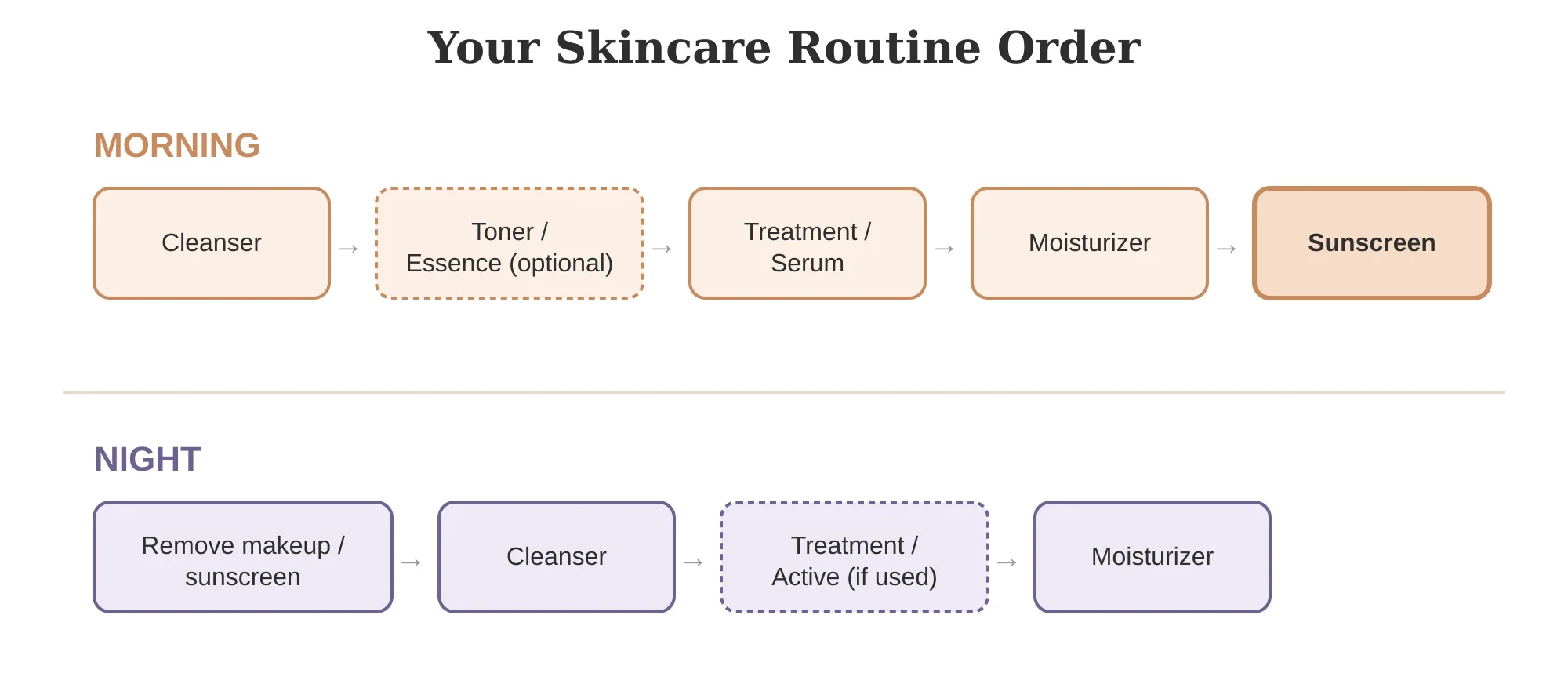
Your full AM and PM routine order at a glance
Start With What Your Skin Actually Needs
Before adding anything new, separate two questions people mix up.
What does my skin need? This is about your skin’s general behaviour: dry, oily, combination, sensitive, easily irritated. This helps you choose the right products for your skin.
What am I trying to change? This is your actual concern: dullness, breakouts, dark spots, fine lines. It’s separate from your skin type, this is where treatments can help.
You can have dry skin and dark spots at the same time. Your cleanser and moisturizer get chosen around the dry part. Your treatment gets chosen around the dark spots. They’re not the same decision, and treating them like one decision is usually where the confusion starts.
If dark spots are your main concern, our Dark Spots on Face guide explains the common causes and which ingredients can actually help fade them.
There’s no right age to care about this either. Whether you’re just starting in your twenties or helping a teenager build their first routine, the logic stays the same, know what your skin needs before you add anything.
Build Your Basic Routine First
The basic routine
A basic routine can be built around three things: a gentle cleanser, a moisturizer, and daytime sun protection. You do not need a long shelf of products before your routine can make sense.
When you actually need a treatment
A treatment earns its place when you have an actual goal for it, not because a Reel said it was essential. If you can’t say what a product is supposed to do for your skin, it’s probably not something you need yet.
One habit worth building early: patch test anything new, a treatment or even a new cleanser. A small amount on your arm or jaw for a day or two tells you a lot before it touches your whole face.
With the basics sorted, here is the full skincare routine order for morning and night, step by step.
Morning Skincare Routine Order
Cleanser. Some mornings, a rinse is enough if your skin isn’t oily overnight. I personally use a mild cleanser in the morning, my skin doesn’t need much at that point.
Toner, if you use one. Optional. Keep it if it adds something. Skip it if it doesn’t.
Treatment or serum, if needed. This is usually where vitamin C or niacinamide goes, alongside sunscreen. I alternate the two, vitamin C one morning, niacinamide the next, instead of using both daily. It just felt like a simpler way to introduce both without overloading my skin. If you’re using vitamin C mainly for pigmentation, our Best Vitamin C Serums for Dark Spots guide compares options based on vitamin C type, strength and skin tolerance.
Moisturizer. Keeps skin comfortable and locks in whatever you applied.
Sunscreen. Non-negotiable, and it goes last. Look for broad-spectrum SPF 30 or higher. The American Academy of Dermatology has a good breakdown on choosing and applying it correctly. If sunscreen tends to feel heavy or you’re worried about breakouts, our Best Sunscreens for Acne-Prone Skin guide can help you find an option that better suits acne-prone skin.
Night Skincare Routine Order
Remove makeup first if needed, and make sure the day’s sunscreen and buildup are properly cleansed away. How much cleansing you need depends on what you wore and how well your cleanser removes it; double cleansing is not automatically necessary for everyone.
Cleanse. This is where a slightly more thorough cleanse than the morning one usually makes sense, since you’re removing the day’s buildup.
Treatment or active, if used. A retinoid is commonly used in the evening, but the exact way you layer it can depend on the product, your skin and any medical instructions. If a prescription is involved, follow those directions rather than a generic routine chart.
Moisturizer. Closes out the routine and helps with any dryness an active might cause.
For another dermatologist-reviewed example of how products can be sequenced, see Cleveland Clinic’s guide to skincare routine order.
How to Choose a Cleanser and Moisturizer That Make Sense Together
This is genuinely one of the more confusing parts of building a routine: figuring out which cleanser goes with which moisturizer, since so much advice online treats it like a fixed rule. It isn’t, really. It comes down to comfort and tolerance more than any strict formula.
| Skin behaviour | Cleanser direction | Moisturizer direction |
| Dry or tight | Gentle, non-stripping cleanser | Richer, more nourishing moisturizer if it feels comfortable |
| Oily or acne-prone | Gentle cleanser; foaming may suit some people | Lightweight, non-comedogenic option |
| Combination | Balanced, gentle cleanser | Adjust texture depending on how your skin feels day to day |
| Sensitive or reactive | Mild, low-irritation cleanser | Simple, well-tolerated moisturizer |
None of this is a guarantee that the “right” pairing will fix your skin. It’s a starting direction, and your own skin’s reaction matters more than the chart. And if your moisturizer feels hydrating but your skin still looks flat or greasy afterward, our Why Does My Moisturizer Make My Skin Look Dull? guide can help you figure out what may be going on.
If your skin starts feeling tighter or drier as the weather changes, the same idea applies: adjust the basics instead of rebuilding everything. My fall skincare routine guide shows how I decide what to keep, swap or adjust when the season changes.
Matching cleanser and moisturizer texture to how your skin actually behaves
Where Do Treatments and Active Ingredients Fit?
Once your basics and pairing are sorted, treatments target your actual concern, but only some of them, and only when they make sense together. Vitamin C, niacinamide, retinoids, hyaluronic acid, alpha arbutin, exfoliating acids, each does something different, and knowing that helps more than any never-mix chart online.
Hyaluronic acid hydrates, it isn’t a treatment for a specific concern. It pulls moisture into skin and layers easily with almost everything, since its job is hydration, not exfoliation.
Alpha arbutin helps with dullness and dark spots, gently, and is often paired with niacinamide. Results take weeks, not days.
Vitamin C and niacinamide caused genuine confusion for me too, old advice says they cancel each other out, but in most modern formulas that’s not true. I use them on alternate mornings rather than together daily, and it’s worked well without irritation.
Exfoliating acids, AHAs and BHAs, remove dead skin, which is why overuse causes irritation. These are the ones worth being careful about stacking with retinoids. More exfoliation isn’t automatically better.If clogged pores or blackheads are why you’re considering a BHA, our How to Unclog Pores the Right Way guide explains when salicylic acid makes sense and why stronger exfoliation is not always better.
Retinoids can irritate skin early on. I use retinal on alternate nights rather than every night, and after about 20 days of that, alongside my vitamin C and niacinamide mornings, my skin genuinely looked brighter. Everyone’s skin is different, but easing in worked for me. Sunscreen the next morning still matters either way. If you’re just starting and haven’t chosen one yet, our Best Retinol Serums for Beginners guide compares beginner-friendly options and what to look for before you buy.
Stacking strong actives, an exfoliant and a retinoid, on the same night raises irritation risk. Separating them onto different nights, like I do, is the simpler approach for most people building a routine alone.
Viral never-mix charts flatten a lot of nuance. Real compatibility depends on formula and your own skin’s tolerance. The American Academy of Dermatology’s guide to layering skincare products is a solid, non-alarmist place to look further.
| Combination | Simple answer |
| Vitamin C + niacinamide | Generally fine, alternate days if unsure |
| Niacinamide + alpha arbutin | Generally fine, commonly paired |
| Hyaluronic acid + anything | Generally fine, low risk |
| Niacinamide + retinoid | Generally fine |
| Retinoid + exfoliating acids | May irritate, separate nights |
| Several exfoliants at once | Easy to overdo |
| Vitamin C + sunscreen | Complementary, doesn’t replace SPF |
Already Own Too Many Products? Try the TBT Routine Rescue
If your shelf looks like a small pharmacy, cleanser, toner, hyaluronic acid, vitamin C, niacinamide, an exfoliant, a retinol, moisturizer, facial oil, sunscreen, the question isn’t how to fit it all in. It’s which of these deserves a place in your routine. I went through exactly this myself, and it wasn’t until I researched what each product did that I figured out which ones stayed.
Before you sort your skincare routine order out further, sort what you own into four groups.
Base: cleanser, moisturizer, sunscreen. Non-negotiable.
Targeted: whatever addresses a real concern right now, vitamin C, niacinamide, a retinoid, an exfoliant.
Optional: toner, essence, facial oil, depending on preference.
Do not automatically stack: owning several actives doesn’t mean using them all together, or even the same night.
This alone can cut a ten-product shelf into a routine that actually makes sense.
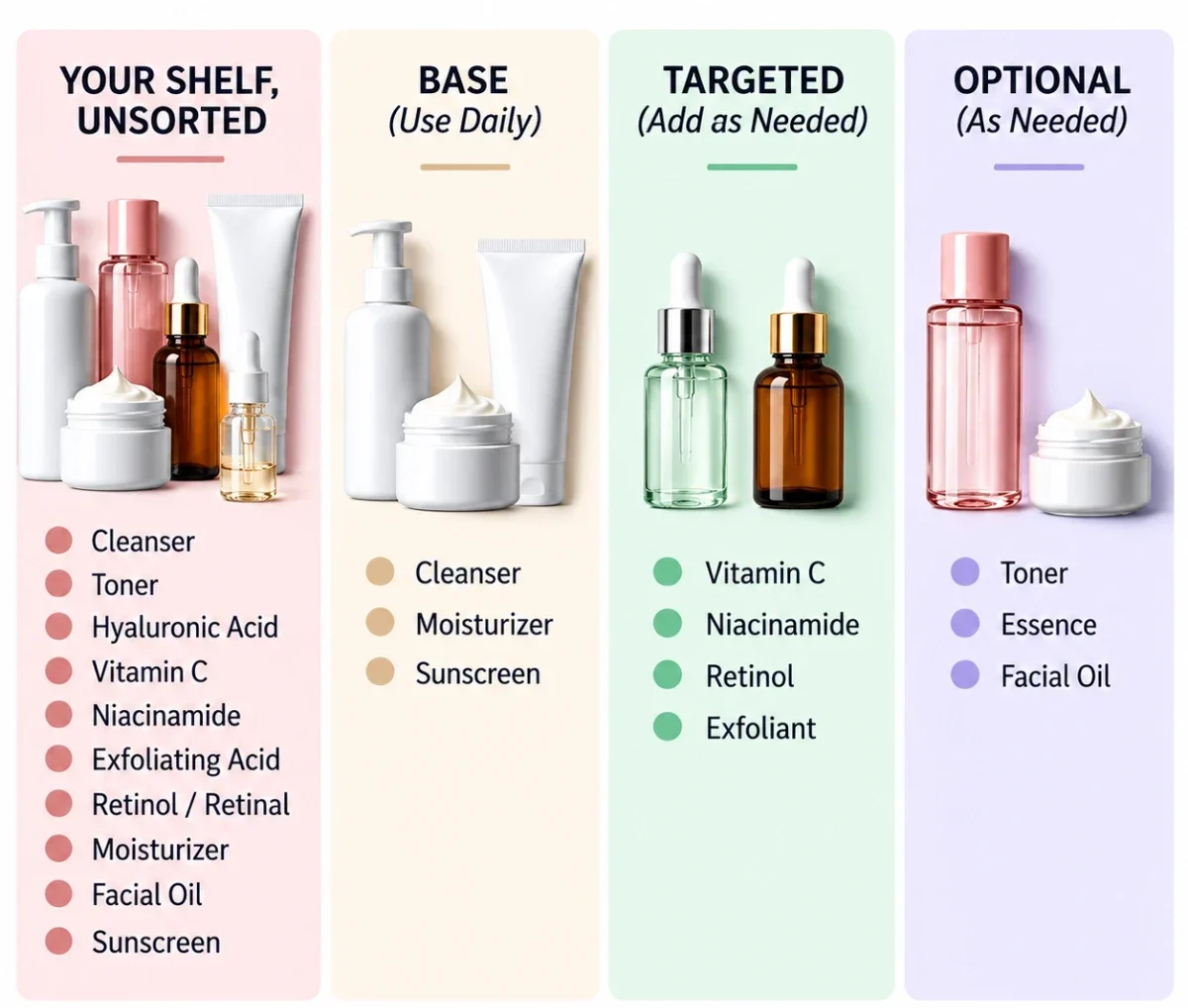
Sort what you own by purpose, not by how much shelf space it takes up
Do You Need to Wait Between Skincare Layers?
Not really, and not in the dramatic way it’s sometimes described. There’s no universal number, thirty seconds or twenty minutes, that fits every product. Follow specific instructions when given. Otherwise, let each layer settle before the next one.
Why Your Skincare Routine May Not Be Working
It’s tempting to blame the wrong order when a routine isn’t working, but that’s rarely the full story. More often it’s inconsistent use, too many products causing irritation, unrealistic timelines, or switching products before giving them a fair chance. My own breakout wasn’t about order at all, it was the wrong cleanser strength at the wrong time of day.
Sometimes a concern is genuinely outside what a cosmetic product can fix. If irritation persists, or you’re combining prescription treatments with over-the-counter actives and aren’t sure how, find a board-certified dermatologist rather than guessing further.
The Beginner Rule to Remember
Start simple. Add a product because you have a real reason for it. Know where it belongs in your day. Give your skincare routine order some consistency before deciding it isn’t working and changing everything again. That’s what actually turned things around for me, not more products, just understanding the ones I had.
Pingback: Best Salicylic Acid Cleansers for Blackheads: 6 Picks
Pingback: Fall Skincare Routine: What to Change as Weather Cools
Pingback: Everything Shower Routine: The Ultimate Guide, Step by Step
Pingback: Chemical Exfoliation Explained: simple AHA, BHA & PHA Guide
Pingback: Moisturizer or Sunscreen First? The Simple Answer