
An acne skincare routine does not need to be complicated. In fact, using too many strong ingredients at once can leave your skin dry, irritated and harder to manage.
A good routine focuses on a few basics: keeping the skin clean without stripping it, using an effective acne treatment, maintaining enough moisture, and protecting the skin from the sun. The challenge is knowing what actually helps, what can make acne-prone skin more irritated, and how to keep your routine consistent enough to see results.
In this guide, we’ll break down what an acne skincare routine should include, common mistakes to avoid, how morning and night routines can differ, and what to do when your routine doesn’t seem to be working.
Table of Contents
Acne Skincare Routine: The Short Answer
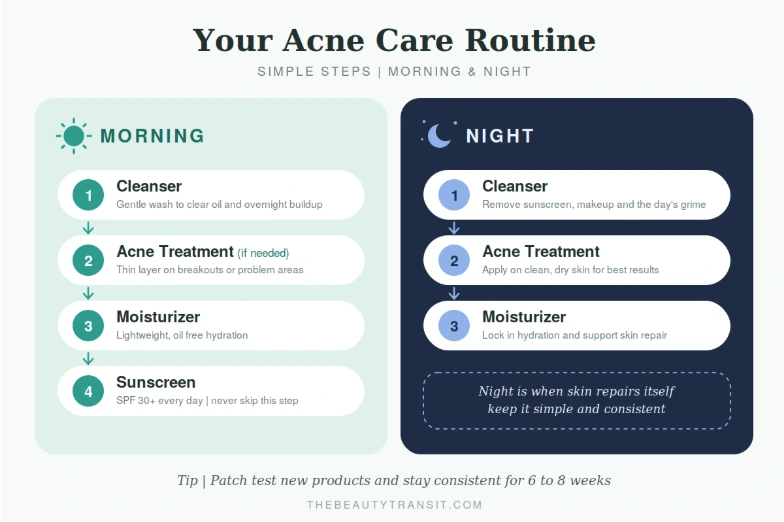
Morning: Cleanser → Acne treatment if needed → Moisturizer → Sunscreen
Night: Cleanser → Acne treatment → Moisturizer
That is the basic framework. Your exact treatment and how often you use it will depend on the product, your skin and professional advice where needed.
At a Glance: What Does Each Step Actually Do?
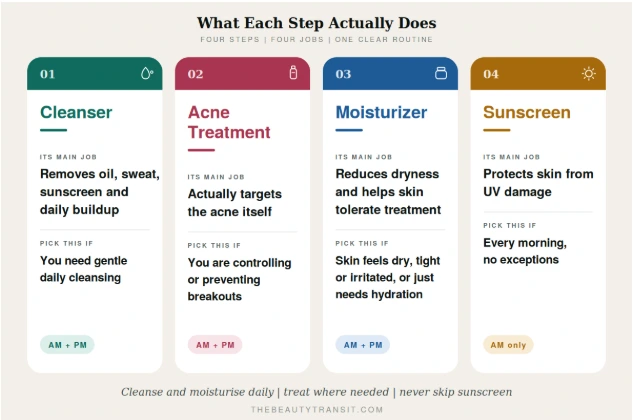
The important part is that your cleanser, moisturizer and sunscreen do not all need to double as acne treatments.
That distinction can make an acne routine much easier to manage.
The 4 Jobs of an Acne Skincare Routine
1. Clean — Keep It Gentle
Cleansing removes oil, sweat and buildup, but washing harder will not clear acne faster.
The American Academy of Dermatology (AAD) recommends gently washing acne-prone skin up to twice a day and after sweating. Use a gentle, non-abrasive cleanser and your fingertips rather than scrubbing with washcloths or sponges.
More washing is not necessarily better. Mayo Clinic also warns that excessive washing and scrubbing can worsen acne.
Do You Need an Acne Cleanser?
Not always. If you already use a leave-on acne treatment or your skin is easily irritated, a gentle cleanser may be enough.
A cleanser with salicylic acid can be useful when you also want help with clogged pores. Mayo Clinic notes that salicylic acid can help unclog pores and comes in both wash-off and leave-on formulas.
The goal is to choose a cleanser that fits the rest of your routine, not simply the strongest one.
Related TBT guide: Best Salicylic Acid Cleansers for Blackheads.
2. Treat — Let the Acne Treatment Do Its Job
This is the step that directly targets your breakouts. Choose one main treatment and use it consistently rather than adding several acne actives at once.
Different treatments work in different ways, so we’ll explain which one may fit your routine and how to use it below.
Common Acne Treatments and Where They Fit
Benzoyl peroxide: helps reduce acne-causing bacteria and also helps remove excess oil and dead skin cells. Higher strength does not automatically mean better results. Mayo Clinic notes that starting with a lower-strength 2.5% product can reduce the risk of side effects such as dryness and irritation. It can also bleach hair and fabrics.
Adapalene: is a topical retinoid. It helps unclog pores and prevent new breakouts rather than working only on the pimple you can see today. Dryness and irritation can occur, especially when starting.
Salicylic acid: helps unclog pores and can help prevent new breakouts. It appears in cleansers as well as leave-on treatments.
Azelaic acid: can help with acne and may also improve the dark marks that remain after acne clears.
These are options, not a shopping list.
Your Whole Routine Does Not Need to Fight Acne
This is one of the easiest mistakes to make.
You buy an acne cleanser. Then an exfoliating toner. Then an acne serum. Then a retinoid. Then a spot treatment.
Suddenly almost every step contains an active.
A better acne skincare routine gives products clear jobs.
Your cleanser can simply cleanse. Your moisturizer can simply moisturize. Your sunscreen can simply protect. Your treatment can do the targeted acne work.
That does not mean acne treatments can never be combined. AAD guidelines include combination approaches. But combinations should have a purpose rather than being a random stack of actives.
Starting Slowly Can Be Smarter Than Starting Strong
Some topical acne treatments can irritate the skin when you first introduce them.
NICE guidance recommends considering alternate-day or short-contact application for irritating topical treatments such as benzoyl peroxide or retinoids, then progressing if tolerated.
Always follow the directions for your specific product or your clinician’s instructions.
Important: topical retinoids such as adapalene are contraindicated during pregnancy and when planning a pregnancy, according to NICE guidance.
3. Support — Moisturizer Still Belongs Here
Oily skin can make moisturizer feel unnecessary.
Acne treatments can make it even more tempting to skip it because you may think drying the skin means drying out the acne.
That is not the goal.
Benzoyl peroxide, salicylic acid and topical retinoids can all cause dryness or irritation. The AAD notes that using moisturizer can help skin tolerate these treatments.
So moisturizer is not the step working against your acne skincare routine. It may be the step helping you stick with it.
What Makes a Moisturizer Acne-Friendly?
Look for non-comedogenic, oil-free, or won’t-clog-pores formulas. Choose a texture that feels comfortable on your skin—lighter lotions or gel-creams often suit oily skin well.
Need help choosing one? See our Best Moisturizers for Oily and Dull Skin guide.turizer only because the packaging says “for acne.” Its main job here is moisturizing.
4. Protect — Sunscreen Is Part of the Routine
Sunscreen can feel like an extra beauty step. It isn’t.
Use broad-spectrum SPF 30 or higher on exposed skin during the day. For acne-prone skin, look for formulas labelled non-comedogenic or “won’t clog pores.” This becomes especially relevant if breakouts leave discoloration behind.
Related TBT guide: Best Sunscreens for Acne-Prone Skin.
Your Morning Acne Skincare Routine
Step 1: Cleanse
Gently cleanse your face. Avoid scrubbing or trying to make your skin feel “squeaky clean.”
Step 2: Use Your Acne Treatment If Needed
After cleansing, apply your acne treatment. This is the main treatment step in your morning routine, so you usually do not need to layer several acne actives at once.
If you use a leave-on benzoyl peroxide treatment, apply a thin layer to clean, dry skin before moisturizer. If benzoyl peroxide is already in your cleanser, you do not need to automatically follow it with another benzoyl peroxide product.
If you use azelaic acid in the morning, apply it after cleansing and before moisturizer. It can usually fit comfortably into a simple morning routine without adding another exfoliating treatment on top.
If you use a salicylic acid leave-on treatment, it also goes after cleansing and before moisturizer. But if you have already cleansed with a salicylic acid cleanser, adding another salicylic acid product immediately afterward may be more than your skin needs.
And if adapalene is your main acne treatment, you can keep it for your nighttime routine. Your morning routine does not need an extra acne active simply because you are not treating with adapalene at that moment.
Step 3: Moisturize
Apply an acne-friendly moisturizer, especially if your treatment leaves your skin dry or uncomfortable.
Step 4: Apply Sunscreen
Finish with broad-spectrum SPF 30 or higher.
A basic morning acne skincare routine may really be that short.
Your Night Acne Skincare Routine
Step 1: Remove Makeup and Sunscreen
If needed, remove makeup and sunscreen before cleansing so you are not leaving the day’s buildup on your skin overnight.
Step 2: Cleanse
Use your regular gentle cleanser unless an acne cleanser has a specific role in your routine.
Step 3: Apply Your Acne Treatment
Choose your night treatment based on what you used in the morning.
If you used benzoyl peroxide in the morning, you can keep adapalene for night instead of repeating benzoyl peroxide.
If you used salicylic acid in the morning, avoid adding more exfoliating acids at night, especially if your skin feels dry or irritated.
If you used azelaic acid in the morning, you can use adapalene at night if it is already part of your routine.
If you already use retinol at night, don’t add adapalene on top of it. Both are retinoids. For an acne-focused routine, adapalene is the more established acne treatment.
When starting adapalene, keep the rest of your nighttime routine simple and moisturize afterward.
Step 4: Moisturize
Finish with moisturizer to help manage dryness and irritation.
Confused about where toners, serums, eye creams or other products fit? See our Skincare Routine Order guide.
Does Every Product Need to Say “Acne” on the Label?
No.
And this is worth remembering when you shop.
An acne skincare routine is not automatically better because you have an acne cleanser + acne toner + acne serum + acne spot treatment + acne moisturizer.
Sometimes that simply gives your skin several products trying to do similar jobs.
Instead, think about the routine as a small team:
- Cleanser: clean
- Treatment: treat
- Moisturizer: support
- Sunscreen: protect
If a product does more than one job and your skin tolerates it, fine. But every step does not need an acne active.
Can You Use More Than One Acne Treatment?
Sometimes.
AAD guidelines support treatment combinations that use different mechanisms of action.
But that is very different from layering several actives without a plan.
Mayo Clinic notes that stubborn acne may sometimes benefit from more than one active ingredient, including using different products at different times of day to reduce irritation.
Before Adding Another Active, Ask One Question
What job will this product do that my current routine isn’t already doing?
If you cannot answer that clearly, you may not need it yet.
If you’re introducing another treatment, also think about whether it is adding a new function or simply duplicating an existing one.
How Much Is Too Much in an Acne Skincare Routine?
There is no magic number of products that becomes “too many.” Your skin gives you better clues.
- Burning
- Stinging
- Excessive peeling
- Tightness
- Dryness
- Irritation
Some initial irritation can occur with acne treatments, but worsening discomfort should not simply be treated as proof that a product is “working.”
NICE specifically recognizes irritation from treatments such as benzoyl peroxide and topical retinoids and recommends strategies to improve tolerance.
What Doesn’t Belong in an Acne Skincare Routine?
Harsh Scrubs
You cannot scrub acne away. Aggressive scrubbing can irritate acne-prone skin.
Too Many Exfoliating Products
One exfoliating product may have a reason to be there. Three products doing essentially the same thing may simply increase irritation.
Constantly Changing Treatments
AAD recommends giving acne products time rather than repeatedly switching products. Trying too many products can stress and irritate the skin.
Picking and Squeezing
Picking is not an acne treatment. It can make inflammation and the marks left behind harder to deal with.
Products You’re Using “Just Because”
This is our simplest rule: Make every step earn its place. If you cannot explain what a product contributes to your acne skincare routine, reconsider whether you need it.
Your Acne Routine Isn’t Working — Don’t Rebuild Everything Yet
This is where people often go from a reasonable routine to a complicated one.
A new breakout appears, so another serum gets added. Then another acid. Then a stronger cleanser.
Before rebuilding the whole routine, troubleshoot it.
1. Are You Actually Using the Routine Consistently?
A treatment cannot show you what it can do if you use it randomly. Follow its directions and give it an appropriate trial unless irritation or another problem means you should stop.
2. Is Your Skin Tolerating the Routine?
Separate these two situations: still getting acne + skin feels comfortable, and still getting acne + skin is burning, peeling and tight. They are not the same problem. The second situation should not automatically lead to another acne active.
3. Did You Change Several Things at Once?
If you replace your cleanser, treatment and moisturizer together and your skin gets worse, identifying the problem becomes difficult. When possible, make deliberate changes rather than rebuilding everything overnight.
4. Are You Giving Treatment Enough Time?
Acne treatment is rarely an overnight process. Mayo Clinic notes that nonprescription topical acne products may take 2 to 3 months of daily use before results become apparent. That does not mean you should tolerate severe irritation for months. It means “I still have a pimple after one week” is not necessarily proof that your entire routine has failed.
Try an Acne Routine Reset When Your Shelf Gets Too Complicated
If you can no longer explain what half the products in your routine are doing, simplify the picture.
Think again about the four jobs: Clean → Treat → Support → Protect.
That might mean returning to: Gentle cleanser + appropriate acne treatment + moisturizer + daytime sunscreen.
When Your Acne Is Improving, Don’t Keep Escalating
Clear skin does not always happen all at once.
- Fewer new breakouts
- Less inflammation
- Existing spots healing
- Better tolerance of treatment
- Longer periods between breakouts
If the routine is working and your skin is tolerating it, you do not automatically need to add another active because you saw a new product online.
Small Habits That Can Work Against Your Routine
Products are not the only part of acne care.
Wash after heavy sweating rather than leaving sweat sitting on acne-prone skin. Avoid aggressive scrubbing. Keep products that tend to clog your pores away from acne-prone areas, and choose non-comedogenic skincare where practical. AAD face-washing guidance supports gentle cleansing practices.
How Long Should You Give an Acne Skincare Routine?
Acne rarely clears overnight, but that doesn’t mean your routine isn’t working. You may start noticing fewer new breakouts or calmer-looking skin before your acne fully clears.
Mayo Clinic notes that nonprescription topical treatments may take 2 to 3 months of consistent use to show visible results. NICE commonly assesses first-line acne treatments over about 12 weeks.
So give your routine time. Small improvements count—and clearer skin is usually a gradual process, not an overnight change.
When an Acne Skincare Routine Isn’t Enough
Skincare has limits.
Persistent acne, deep or painful breakouts, acne that is leaving scars, or acne that is not responding to an appropriate routine deserves professional assessment.
Prescription acne treatment can include topical combinations as well as oral treatments depending on acne severity and the individual. Current AAD guidelines include topical treatments, oral antibiotics, hormonal therapies and isotretinoin among evidence-based options used in appropriate cases.
Frequently Asked Questions About an Acne Skincare Routine
How many products do I need for an acne skincare routine?
You do not need a fixed number. A basic routine can consist of a cleanser, an appropriate acne treatment, moisturizer and sunscreen during the day. Add another product only when it has a clear purpose.
Should I moisturize if I have oily, acne-prone skin?
Yes, oily skin can still need moisturizer. This is especially important when acne treatments are causing dryness or irritation. Look for products labelled non-comedogenic, oil-free or “won’t clog pores.”
Can I use salicylic acid and adapalene in the same routine?
Different acne treatments can sometimes be combined, but using multiple irritating actives can make a routine harder to tolerate. How you combine them depends on the products, your skin and your treatment plan. If you’re unsure, ask a dermatologist or pharmacist rather than stacking them yourself.
Why is my acne skincare routine making my skin peel?
Ingredients such as benzoyl peroxide and topical retinoids can cause dryness and irritation, particularly when introduced. Starting gradually can sometimes improve tolerance. Persistent or severe irritation deserves professional advice.
Should I change my acne routine if I’m still breaking out?
Not automatically. First check how long you have used the treatment, whether you’re using it consistently and whether your skin is tolerating it. Some nonprescription treatments can take 2 to 3 months to show results.
The Bottom Line
A good acne skincare routine can stay simple: clean, treat, moisturize and protect. Choose the right treatment, stay consistent, and give your skin time to improve.
Pingback: Skin Cycling Routine: A Simple 4-Night Guide for Beginners