
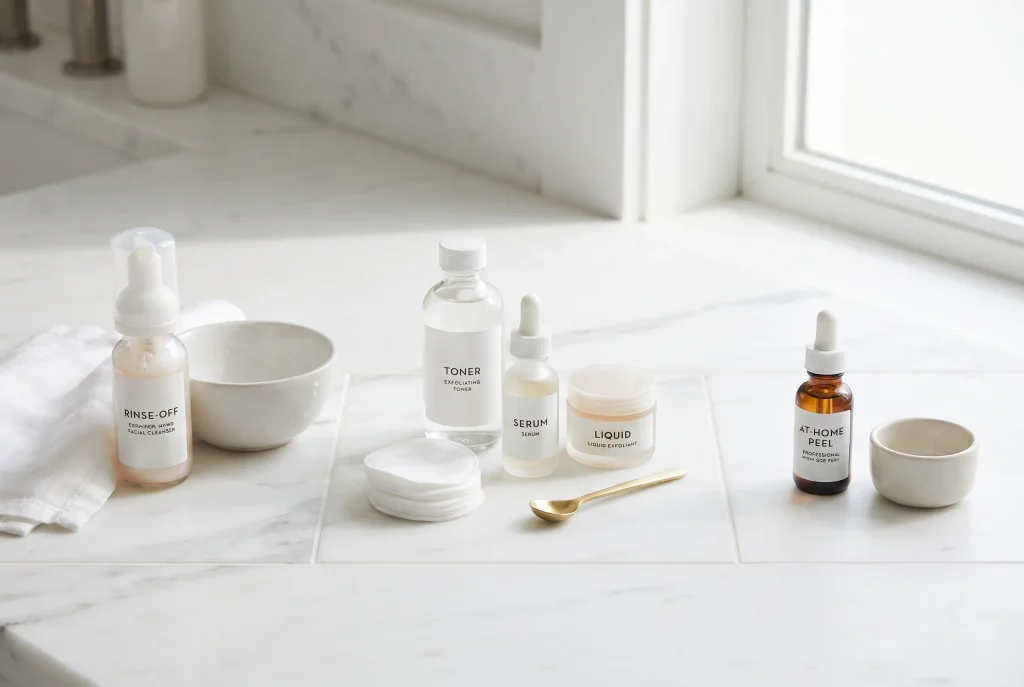
Chemical exfoliation sounds more complicated than it really is. But once you have chemical exfoliation explained in simple terms, AHA, BHA and PHA become much easier to understand.
You see AHA, BHA, PHA, percentages and acid names on bottles, and suddenly choosing one feels like a chemistry lesson.
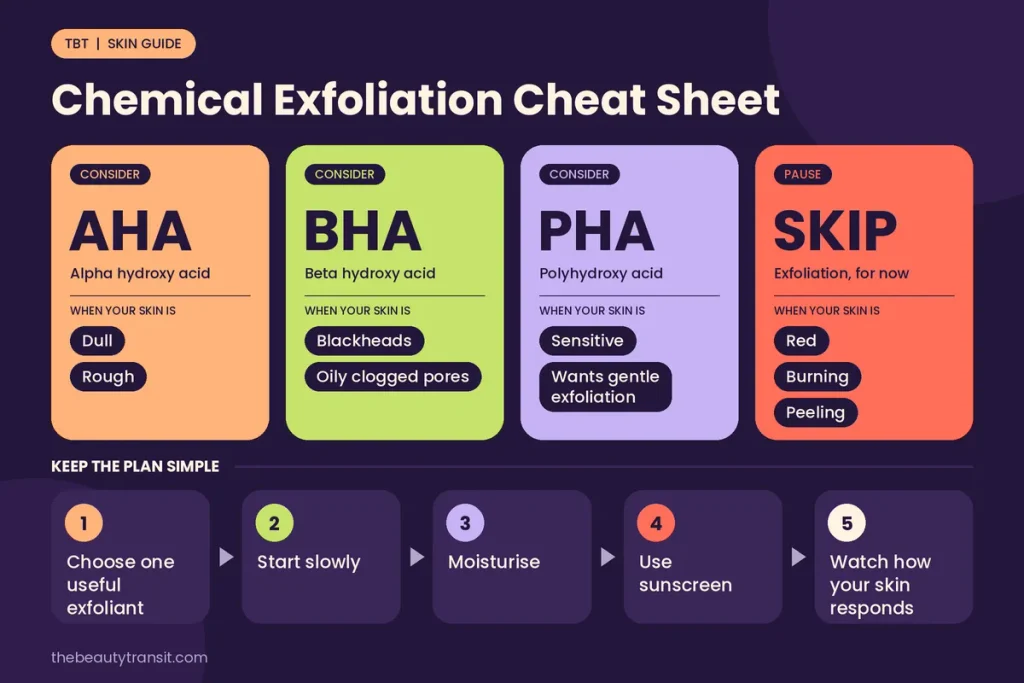
In simple terms, chemical exfoliants use acids to help remove built-up dead skin cells. AHA mainly targets dull, rough surface skin. BHA is useful for oily, clogged pores. PHA is a gentler option.
The best choice is not the strongest acid. It is the one that matches what your skin actually needs.
Table of Contents
What Is Chemical Exfoliation?
Your skin naturally sheds old cells. When those cells collect on the surface, skin can look dull, flaky or rough. Chemical exfoliation uses ingredients that help loosen and remove this buildup. It can also help with clogged pores and uneven texture.
Good chemical exfoliation does not have to make your face peel. The goal is smoother, clearer-looking skin without leaving it sore.
Chemical vs Physical Exfoliation
Physical exfoliation uses friction from a scrub, brush or tool. Chemical exfoliation uses ingredients such as hydroxy acids or enzymes. The American Academy of Dermatology notes that both methods exfoliate in different ways.
Neither method is automatically better. Problems start when you scrub too hard or stack exfoliants.
Do You Actually Need to Exfoliate?
Chemical exfoliation is optional. It can make sense if dullness, rough texture, blackheads or clogged pores are bothering you. But if your skin already feels smooth and comfortable, you do not need an acid just because it is trending.
If your skin is red, burning, peeling or unusually sensitive already, skip exfoliation for now. Let irritated skin settle first.
Chemical Exfoliation Explained: AHA vs BHA vs PHA
The easiest way to understand chemical exfoliation is to think about the job each acid family does.
AHA — For Dullness, Texture and Uneven-Looking Tone
AHA means alpha hydroxy acid. AHAs are water-soluble and mainly work on the skin surface. They are commonly used for dullness, rough texture and uneven-looking tone.
Glycolic acid has a small molecular size and can feel stronger. Lactic acid exfoliates while also having humectant properties. Mandelic acid has a larger molecular size and may feel gentler for some beginners. Other AHAs include citric, malic and tartaric acid.
The point is simple: all AHAs are not identical. Two products labelled AHA can behave very differently.
BHA — For Blackheads, Oil and Clogged Pores
In skincare, BHA usually means salicylic acid. It is oil-soluble, which makes it especially useful when oil and dead cells collect inside pores. Think blackheads, whiteheads and oily congestion.
If clogged pores are your main concern, read How to Unclog Pores the Right Way. It explains why squeezing and aggressive scrubbing do not stop pores from filling again.
BHA is useful, but it cannot fix every breakout. Deep, painful or persistent acne may need a wider treatment plan. See our Acne Skincare Routine for that bigger picture.
PHA — The Gentler Option
PHA means polyhydroxy acid. Common examples include gluconolactone and lactobionic acid. Their larger molecular size means slower penetration, which may suit skin that struggles with stronger acids.
Gentler does not mean useless. A milder product that works without irritation is a better match than forcing something stronger.
What About Enzyme Exfoliants?
Some exfoliants use enzymes such as papain from papaya or bromelain from pineapple. They work differently from AHA, BHA and PHA but still help loosen dead surface cells.
How to Choose the Right Chemical Exfoliant
Start with your concern. Dull and rough? Consider AHA. Blackheads and oily clogged pores? BHA may make more sense. Sensitive and looking for something gentler? PHA or a gentler AHA may be easier to try.
Do not choose chemical exfoliation by percentage alone. Acid type, concentration, pH, contact time and skin tolerance all matter. A higher number is not automatically a better product.
Cleanser, Toner, Serum or Peel: Does the Format Matter?
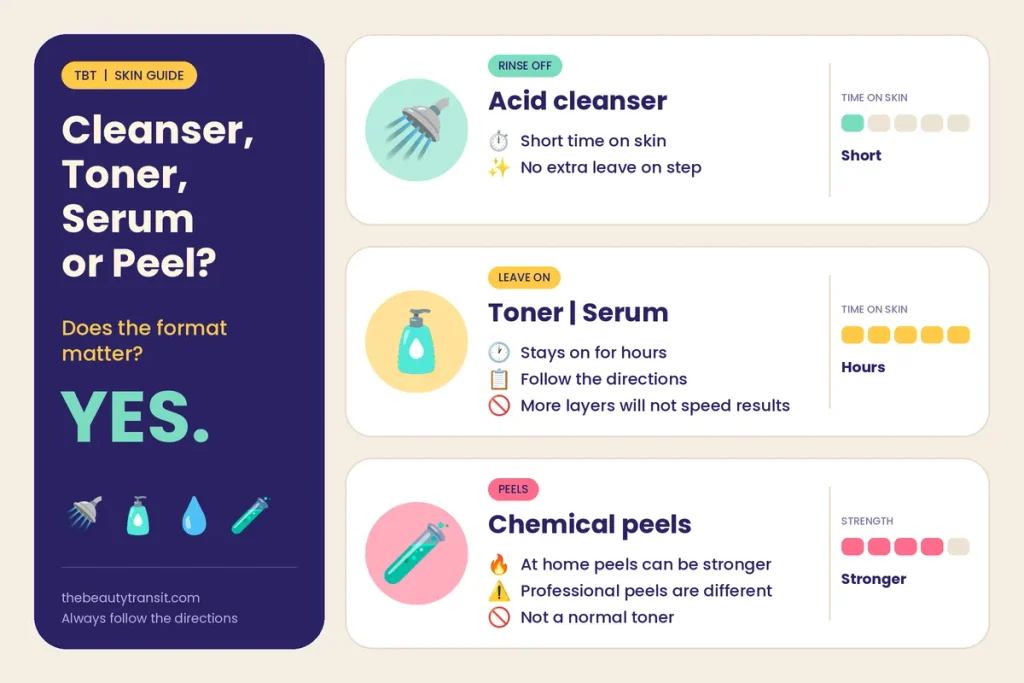
Yes. A cleanser is rinsed away, while a toner or serum can stay on your skin for hours. That contact time changes how the product fits into a routine.
Rinse-Off Exfoliants
An acid cleanser gives the ingredient a shorter time on your skin and can be a simple way to include chemical exfoliation without another leave-on step.
Leave-On Exfoliants
Toners, liquids and serums stay on the skin. Follow their directions and avoid assuming that more layers will give faster results.
Chemical Peels
At-home peels can be stronger than everyday acid products. Professional chemical peels are another category and should not be treated like a normal toner.
How to Add Chemical Exfoliation to Your Routine
Simple PM routine: Cleanser → leave-on exfoliant → moisturiser.
If your cleanser already contains an exfoliating acid, you may not need another acid straight after it. If product order gets confusing, use our Skincare Routine Order guide.
How Often Should You Exfoliate?
There is no perfect schedule for everyone. Start cautiously, follow the product directions and increase only if your skin stays comfortable. Daily exfoliation is not a skincare achievement. The right frequency is the lowest one that gives useful results without irritation.
The One-Exfoliant Rule for Beginners
An acid cleanser, exfoliating toner, acid serum and weekly peel may look like separate products, but together they can mean repeated chemical exfoliation.
Start with one main exfoliant. Give it time before deciding you need another. It also makes reactions easier to trace.
Can You Use Chemical Exfoliants With Other Actives?
AHA + BHA
Some formulas contain both. That does not mean a beginner needs to layer separate AHA and BHA products in the same routine.
Retinoids and Benzoyl Peroxide
Retinoids, benzoyl peroxide and exfoliating acids can all contribute to dryness or irritation. The AAD advises considering products such as retinol, prescription retinoids and benzoyl peroxide before exfoliating because the combination may worsen dryness or sensitivity. Alternating nights can keep things simpler.
Vitamin C, Niacinamide and Peptides
These ingredients are not automatically banned with acids. Ask whether your skin needs them all at once. Simple routines are easier to tolerate and troubleshoot.
Not Every “Acid” Is an Exfoliating Acid
Hyaluronic acid is mainly used for hydration. Tranexamic acid is used for discoloration concerns. Azelaic acid has several actions of its own and should not simply be treated as another AHA or BHA.
So the word “acid” on an ingredient list does not automatically mean you are adding another chemical exfoliation step.
Chemical Exfoliation, Dark Marks and Sunscreen
Exfoliation can help with dull surface buildup, but more acid does not mean dark marks will fade faster. Irritation can worsen the problem, especially in skin prone to post-inflammatory marks.
Sun protection matters too. The FDA explains that AHAs can increase skin sensitivity to UV and advises sun protection while using them. If sunscreen is difficult to choose, our Best Sunscreens for Acne-Prone Skin guide includes options for different skin needs.
[IMAGE HOLDER — AHA exfoliation and daily sunscreen safety graphic]
Alt text: Chemical exfoliation explained with AHA use and daily sunscreen protection
How Long Does Chemical Exfoliation Take to Work?
Do not judge a product after three uses. Smoother-feeling skin may show up sooner, while congestion and uneven-looking tone can need more consistent care.
Slow progress is not a reason to immediately add another acid. Give the routine time before changing several things.
Is It Working—or Are You Over-Exfoliating?
Tingling vs Burning
A mild temporary sensation can happen with some formulas, but burning is not proof that chemical exfoliation is working better. Persistent pain or stinging deserves attention.
Purging vs Irritation
Not every new breakout is “purging.” If bumps appear with redness, burning, tightness, flaking or unusual sensitivity, irritation is a bigger concern.
Signs of Over-Exfoliation
Watch for burning, persistent stinging, redness, tightness, dryness, flaking, peeling or products that suddenly sting when they normally do not. These are signs to reduce irritation, not add another exfoliant.
What to Do If You Over-Exfoliate
Pause the exfoliant. Keep the routine simple: gentle cleanser, moisturiser and daytime sunscreen. Once comfortable, reintroduce one exfoliant slowly if needed.
Chemical Exfoliation Mistakes to Avoid
- Starting with the highest percentage.
- Exfoliating too often or stacking several acid products.
- Using strong acids and harsh scrubs together.
- Thinking burning means better results.
- Ignoring sunscreen or exfoliating already irritated skin.
- Calling every breakout purging.
- Changing products before giving a sensible routine time to work.
When an Exfoliant Isn’t the Answer
Deep or painful acne, scarring, severe irritation or persistent pigmentation may need professional assessment—not a stronger acid. Sometimes the right next step is not more exfoliation.
The TBT Chemical Exfoliation Cheat Sheet
FAQs
Which Chemical Exfoliant Is Best for Beginners?
PHA, lactic acid or mandelic acid can be gentler starting options. For clogged pores, salicylic acid may make more sense.
Is AHA or BHA Better for Clogged Pores?
BHA, usually salicylic acid, is generally the more direct choice for oily clogged pores because it is oil-soluble.
Is AHA or BHA Better for Dark Spots?
AHAs can help surface dullness, but dark spots have different causes. Aggressive exfoliation is not a complete pigmentation plan.
Can Sensitive Skin Use Chemical Exfoliants?
Sometimes. A gentler formula such as PHA may be easier to tolerate. Already irritated skin should be allowed to recover first.
Can I Use AHA and BHA Together?
Yes, some products are formulated with both. Beginners usually do not need to layer separate AHA and BHA treatments.
Can I Use Chemical Exfoliants With Retinol?
Both can fit a routine, but together may irritate. Alternating nights can be easier.
Can I Exfoliate Every Day?
Not necessarily. Follow your product directions and your skin. More frequent chemical exfoliation does not automatically mean better results.
Morning or Night: When Should I Exfoliate?
Either may work depending on the product. Many people prefer night because it keeps an active routine simple. Use sunscreen during the day.
Does Chemical Exfoliation Cause Purging?
Do not call every reaction purging. Burning, redness and peeling point more toward irritation.
Bottom Line
Chemical exfoliation works best when you choose it for a clear reason. AHA makes sense for dull, rough surface skin. BHA fits blackheads and oily congestion. PHA offers a gentler route. If your skin is already burning or peeling, it probably needs recovery—not another acid.
Choose your exfoliant because its job matches your skin, not because it has the biggest percentage on the bottle.
Pingback: Best Glycolic Acid Cleanser: 5 Picks for Smoother Skin