
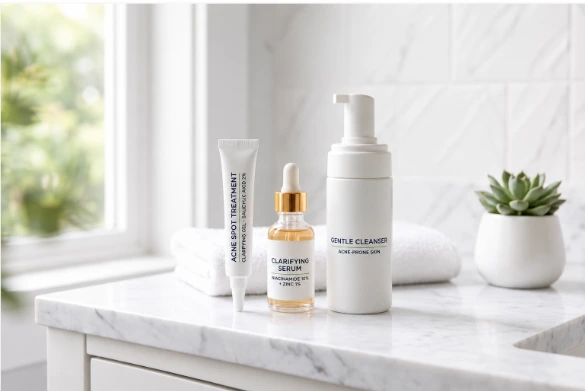
If painful pimples keep returning around your chin or jawline, especially around your period, changing cleansers may not solve the whole problem. A good hormonal acne skincare routine is about choosing treatment for a clear reason, keeping the rest gentle, and knowing when skincare alone may not be enough.
The foundation is simple: gentle cleanser, an appropriate acne treatment, moisturizer, and broad-spectrum SPF 30+ in the morning. Salicylic acid, benzoyl peroxide, adapalene, and azelaic acid do different jobs, so the right choice depends on what your breakouts are doing.
Table of Contents
What Is Hormonal Acne — and Does Yours Actually Look Hormonal?
Hormonal acne is acne that is influenced by changes in your hormones. These changes can increase oil production, making clogged pores and inflamed breakouts more likely.
It often follows a pattern. You may notice deep or tender pimples around the chin, jawline, or lower face, with breakouts returning around the same time each month. But jawline acne alone does not mean it is hormonal. Recurring timing and the way your breakouts behave are better clues than location alone.
Common Signs of a Hormonal Pattern
A hormonal pattern is more likely when breakouts are cyclical. You may notice deep or tender pimples on the chin, jawline, or lower face, acne around menstruation, or adult breakouts that return in the same areas. Location alone cannot confirm the cause: jawline acne is a clue, not a diagnosis.
When Another Trigger May Be Involved
Before assuming hormones are responsible, consider recent changes. Hair products, makeup, pore-clogging skincare, medications, irritation, or another acne-like condition can change how your skin behaves. Mostly blackheads and surface congestion may point more strongly to clogged pores.
| What you notice | What it could suggest | What to consider next |
| Breakouts predictably appear around your period | A hormonal pattern is more plausible | Track timing for a few cycles |
| Deep, recurring lower-face pimples | Common hormonal-pattern presentation | Build a consistent acne plan |
| Acne began after a new skin or hair product | A product may be contributing | Review recent additions |
| Mostly blackheads and clogged pores | Congestion may be prominent | Consider a pore-clearing strategy |
| Acne began after a medication change | Medication may be relevant | Discuss timing with your clinician |
| Persistent acne plus other new hormonal symptoms | May need medical assessment | Speak with a qualified clinician |
Start your hormonal acne skincare routine with the pattern, not a shelf full of actives.
Why Do Hormones Change and Trigger Acne?
Hormone levels naturally change throughout life. They can shift during puberty, your menstrual cycle, pregnancy, perimenopause, and menopause. Starting or stopping some forms of hormonal birth control can also change your hormone balance.
These changes can affect hormones called androgens. Androgens can increase oil production in the skin. When extra oil mixes with dead skin cells, pores can clog more easily and breakouts can follow.
For some people, hormonal acne appears around the same time each month because hormone levels naturally change during the menstrual cycle. Certain medical conditions can also affect hormones, so acne that appears with other unusual symptoms is worth discussing with a doctor.
Stress may make acne worse for some people, but it isn’t accurate to say that stress alone causes every case of hormonal acne.
What Skincare Can – and Can’t – Do for Hormonal Acne
A hormonal acne skincare routine can help keep pores clear, reduce active breakouts, support the skin barrier, and address some post-acne marks. It cannot promise to ‘balance your hormones.’ Topical products treat what is happening in the skin; they cannot correct every internal trigger.
Mild acne may respond well to topical care. Deep, painful, scarring, or persistent acne may need a dermatologist’s assessment.
Which Acne Ingredient Does Your Skin Actually Need?
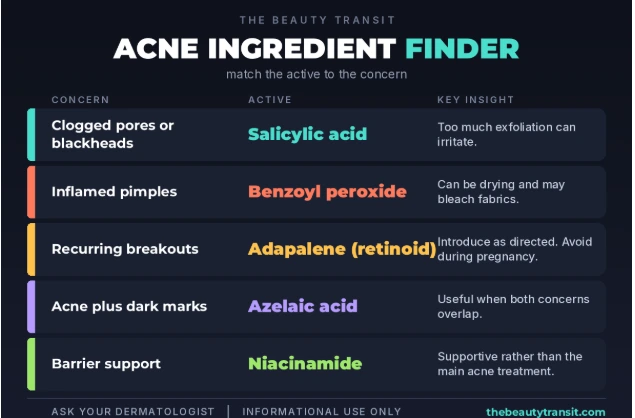
Do not collect every ingredient labelled for acne. Choose the active according to the problem you want it to solve.
Salicylic Acid — When Clogged Pores Are Part of the Problem
Salicylic acid is a beta-hydroxy acid that exfoliates and helps unclog pores. It can suit acne with blackheads, whiteheads, or congestion. It comes in cleansers and leave-on products; you do not automatically need both.
Benzoyl Peroxide — When Pimples Are Inflamed
Benzoyl peroxide reduces acne-causing bacteria and is useful for inflammatory pimples. It can cause dryness, peeling, or irritation, and higher strength is not automatically better. It can also bleach towels and clothing.
Adapalene and Other Retinoids — When Breakouts Keep Returning
Topical retinoids help keep pores clear and prevent new lesions. Adapalene is available without a prescription in the United States, while other acne retinoids may require one. Introduce retinoids carefully because irritation can occur.
Pregnant or trying to become pregnant? The American Academy of Dermatology advises stopping adapalene and other topical retinoids during pregnancy and discussing acne treatment with your clinician.
Azelaic Acid — When Acne and Dark Marks Overlap
Azelaic acid can help when acne and post-acne discoloration overlap, making it useful when active breakouts and lingering marks are both concerns.
Niacinamide — Helpful Support, Not the Main Acne Treatment
Niacinamide can support the skin barrier and is common in products for oily or acne-prone skin. Treat it as support, not a replacement for established acne treatments.
| What is bothering you most? | Ingredient to consider | Main thing to know |
| Clogged pores or blackheads | Salicylic acid | Too much exfoliation can irritate |
| Inflamed pimples | Benzoyl peroxide | Can be drying and bleach fabrics |
| Recurring breakouts | Adapalene | Introduce as directed; avoid during pregnancy |
| Acne + dark marks | Azelaic acid | Useful when both concerns overlap |
| Barrier support | Niacinamide | Supportive rather than the main acne treatment |
A Simple Hormonal Acne Skincare Routine
Once you have chosen an active for a clear reason, keep the rest of the hormonal acne skincare routine simple and consistent.
Morning Routine
- Cleanse gently. Use a mild, non-abrasive cleanser. Acne does not mean your face is dirty. If a salicylic-acid cleanser is your chosen treatment, this may be where it fits.
- Treat if needed. If your main acne treatment belongs at night, you do not need another morning active.
- Moisturize. Oily skin can still become dry or irritated, especially with acne treatments. Choose a moisturizer labelled non-comedogenic or unlikely to clog pores.
- Apply sunscreen. Finish with broad-spectrum SPF 30+ that you can wear daily, especially if acne treatment or post-acne pigmentation is part of your routine.
If you are unsure where each product belongs, our Skincare Routine Order guide explains what goes first without turning the routine into a dozen steps.
Night Routine
- Remove makeup and sunscreen when needed, without aggressive rubbing.
- Cleanse gently. Repeated washing will not make hormonal acne disappear faster.
- Apply your main acne treatment. Use the active selected for your concern rather than layering everything you own.
- Moisturize. This can make drying acne treatments easier to tolerate. If congestion is your main concern, our How to Unclog Pores guide explains pore-clearing options in more detail.
Hormonal Acne Skincare Routine at a Glance: Pick This If…
Don’t Start Every Acne Active at Once
Starting several potentially irritating treatments together can increase irritation and makes it difficult to identify what caused a reaction.
For beginners, use a simple TBT framework: core hormonal acne skincare routine + one main active. Keep cleanser, moisturizer, and daytime sunscreen as the base, then add treatment for a clear reason. Combination therapy can be appropriate, but it should be purposeful rather than random.
How to Adapt the Routine for Sensitive or Easily Irritated Skin
Sensitive skin usually needs a gentler routine, not a longer one. Keep cleansing mild, skip harsh scrubs and unnecessary exfoliating toners, introduce treatment gradually, and protect the skin barrier with moisturizer.
Mild dryness can happen, but persistent burning, significant peeling, painful tightness, or worsening redness deserves attention. Do not add more actives to push through irritation.
What If Hormonal Acne Leaves Dark Spots?
A flat post-acne mark is not the same as an active pimple. Picking and squeezing can increase inflammation and the risk of scars and dark marks, so prevention matters as much as fading old marks.
Azelaic acid can help when acne and discoloration overlap, while daily sunscreen matters when pigmentation is a concern. For a fuller guide, see Dark Spots on Face: What Causes Them and How to Fade Them.
7 Mistakes That Make a Hormonal Acne Skincare Routine Harder to Judge
1. Changing treatments every week
Acne treatment needs time. Constant switching can irritate skin and makes it hard to know what is helping.
2. Using too many actives
More ingredients do not guarantee faster clearing; they may only create dryness and irritation.
3. Scrubbing or over-exfoliating
Aggressive rubbing and over-exfoliating can irritate acne-prone skin.
4. Washing your face too often
Gentle cleansing up to twice daily and after sweating is usually enough. Repeated washing can increase irritation.
5. Trying to dry out oily skin
A squeaky-tight feeling is not proof a cleanser worked better. Over-drying can make treatment harder to tolerate.
6. Skipping moisturizer
If treatment leaves skin dry, an acne-friendly moisturizer can support comfort and consistency.
7. Only treating the pimple you can see
Many acne treatments are used across acne-prone areas to help prevent new lesions, not only on today’s visible spot. Follow the directions for your treatment.
Your Routine Isn’t Working — Check This First
Before making your hormonal acne skincare routine stronger, identify what is actually going wrong.
| What you are noticing | What may be happening | What to reconsider |
| Breakouts return at the same time each month | Hormonal trigger may still be active | Skincare may not address the whole driver |
| Burning, peeling, or strong irritation | Routine may be too aggressive | Remove unnecessary actives and reassess |
| Pimples improved but marks remain | Active acne and pigmentation are now different concerns | Shift part of the plan toward marks |
| Acne began after a new product | The product may be contributing | Review recent additions |
| New pimples keep forming despite spot treatment | Only visible lesions are being treated | Consider a preventive acne strategy |
| No change after 10 days | It may simply be too early | Give an appropriate treatment time |
| Little improvement after a proper trial | Current strategy may not be enough | Consider professional assessment |
How Long Should You Give the Routine?
Think in weeks, not days. The American Academy of Dermatology advises giving an acne treatment about 6 to 8 weeks to see some improvement; more complete clearing can take several months. Significant irritation is a reason to reassess sooner.
Track progress every few weeks. Fewer new pimples, less inflammation, and longer gaps between breakouts can show improvement before skin is completely clear.
When Hormonal Acne Skincare Alone May Not Be Enough
See a dermatologist if hormonal acne is deep, painful, scarring, suddenly worsening, or not improving with consistent treatment.
A dermatologist may prescribe topical treatments, hormonal options such as certain birth control pills or spironolactone, clascoterone, or isotretinoin for severe acne. Some treatments are unsafe during pregnancy, so prescription acne treatment requires medical guidance.
FAQs
Can hormonal acne improve with skincare alone?
Mild acne may improve with topical care, but skincare may not remove an ongoing hormonal trigger. Persistent, painful, or scarring acne deserves professional assessment.
Is salicylic acid or benzoyl peroxide better for hormonal acne?
Neither is automatically better. Salicylic acid suits clogged pores and blackheads; benzoyl peroxide is particularly useful for inflammatory pimples.
Can I use salicylic acid and a retinoid in the same routine?
Some plans use more than one active, but combining irritating ingredients can be difficult for beginner or sensitive skin. Do not assume that more treatment means faster results.
Should I moisturize if hormonal acne makes my skin oily?
Yes. Acne-prone skin can still become dry, especially with treatment. Choose a non-comedogenic moisturizer that suits your skin.
Why does hormonal acne come back every month?
If breakouts repeatedly follow your menstrual cycle, changing hormones may be contributing. Topical treatment can manage acne in the skin without removing the internal trigger.
How long should I try a routine before changing it?
If your skin tolerates the routine, allow roughly 6 to 8 weeks to judge early improvement. Reassess sooner for significant irritation or worsening acne.
When should I see a dermatologist?
See a dermatologist if acne is deep, painful, scarring, persistent despite treatment, suddenly changing, or accompanied by other new symptoms that concern you.
The Bottom Line
The best hormonal acne skincare routine is not the one with the most products. Identify the pattern, choose an active for a clear reason, keep cleansing gentle, moisturize, use sunscreen, and give treatment time. If painful breakouts keep returning despite a sensible routine, the next step may be professional assessment rather than a stronger serum.