
You notice a few dark dots on your skin, so you cleanse a little harder. Maybe you try a scrub or a pore strip too. They look better for a while, but somehow they always come back.
The problem is, those dots may not be clogged pores at all. They could be blackheads, whiteheads, or simply sebaceous filaments that are a normal part of your skin. And treating all three the same way can leave your skin irritated without really fixing anything.
So before we get into how to unclog pores, let’s first figure out what you’re actually seeing. Once you know that, choosing what your skin really needs becomes much simpler.
In this article
First, Make Sure Your Pores Are Actually Clogged
Not every visible pore needs to be “cleaned out.” Blackheads, closed comedones, sebaceous filaments, and naturally visible pores can look similar at first glance, but they aren’t the same thing.
Blackheads vs Whiteheads
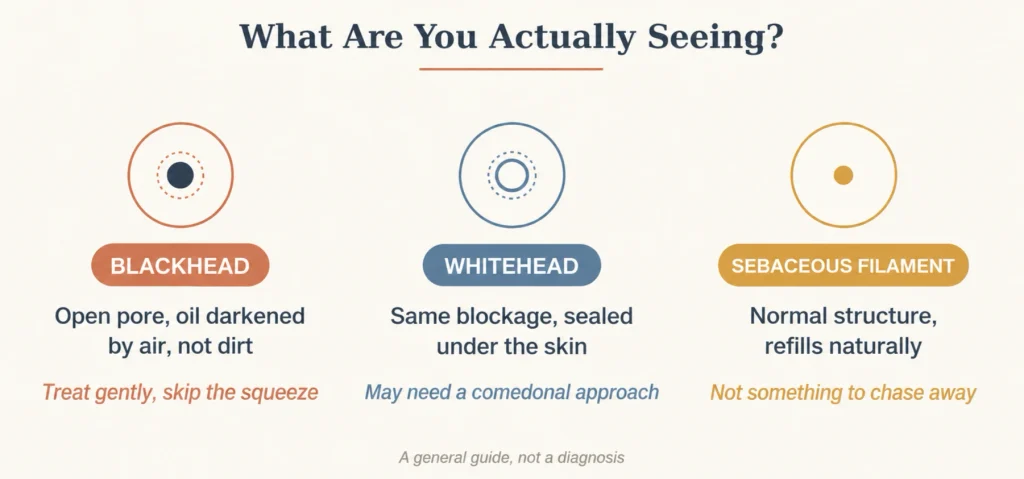
Blackheads: A blackhead forms when a pore gets clogged with oil and dead skin but stays open. The top turns dark when it comes into contact with air. The dark color isn’t dirt, so scrubbing harder wont remove it.
Whiteheads: A whitehead forms when a clogged pore stays closed under the skin. It usually looks like a small white or skin-colored bump.
Very simple distinction: blackhead = clogged and open; whitehead = clogged and closed.
The American Academy of Dermatology’s guide to different types of acne explains that blackheads and whiteheads form when pores become clogged, and specifically notes that the dark dots in blackheads aren’t dirt.
This difference matters. If you think every dark spot is dirt, it’s easy to end up scrubbing, squeezing, and over-cleansing skin that actually needs gentler care.
Sebaceous Filaments
Look closely at the dots on your nose. Are they tiny, fairly uniform, and spread across the same area? They could be sebaceous filaments rather than blackheads.
According to Cleveland Clinic’s guide to sebaceous filaments, sebaceous filaments are normal structures that help move sebum to the surface of the skin. They can look similar to blackheads, but they aren’t actually clogged pores.
That also explains why squeezing them can feel so frustrating. Even if material comes out, the filament can become noticeable again because your skin continues producing sebum. Cleveland Clinic also cautions against squeezing them because the skin can be irritated or damaged.
Does Heavy or Greasy-Feeling Skin Mean Clogged Pores?
Not necessarily.
I sometimes associate that heavy, slippery feeling with my skin not feeling properly clean. But that feeling alone doesn’t tell you whether a pore is actually clogged.
Sebaceous glands naturally produce sebum, while products sitting on the skin, sunscreen, makeup, sweat, and natural oil production can all affect how your face feels during the day.
Instead of judging your pores by whether your skin feels squeaky clean, look for actual signs of congestion.
Are Your Pores Actually Clogged? A Quick Self-Check
| What you see | What it could be | What that means |
| Dark individual plugs | Blackheads | Treat congestion gently. Don’t scrub or squeeze repeatedly. |
| Small white or flesh-colored bumps | Whiteheads | May need a comedonal-acne approach. |
| Tiny, fairly uniform dots around the nose | Sebaceous filaments | Normal structures. Don’t chase permanent removal. |
| Red, tender, inflamed bumps | Inflammatory acne | More than a simple surface-congestion problem. |
| Visible pores without an obvious plug | Naturally visible pores | Visible doesn’t automatically mean clogged. |
This is a general guide, not a diagnosis. If you’re unsure what the bumps are, especially if they’re painful or inflamed, guessing with stronger products can make things worse.
Why Do Pores Get Clogged in the First Place?
Pores can become clogged when oil and dead skin cells build up inside the follicle. That can lead to comedones such as blackheads and whiteheads. The American Academy of Dermatology explains this pore-clogging process in its guidance on acne breakouts.
So clogged pores aren’t proof that your face is dirty.
Certain skincare, makeup, or hair products may also contribute to breakouts in acne-prone skin. The AAD recommends looking for labels such as non-comedogenic or oil-free when products appear to be contributing to breakouts.
This is also why learning how to unclog pores is only half of the problem. Removing what you see today doesn’t necessarily stop the process that created it.
How to Unclog Pores Without Overdoing It
IDENTIFY → SIMPLIFY → TREAT → PROTECT → MAINTAIN
First, identify what you’re actually seeing. Simplify the routine instead of adding every pore product you can find. Choose a treatment that suits the problem. Keep the rest of your routine gentle. Then give it enough time to work.
Start With Gentle Cleansing
Cleanse gently up to twice a day, and after heavy sweating when needed. The AAD’s acne skin-care guidance recommends gentle cleansing rather than scrubbing.
Your cleanser has an important job. It removes surface oil, makeup, sunscreen, and everyday buildup. What it cannot do is mechanically empty every pore.
If you wear makeup or water-resistant sunscreen, make sure it’s properly removed at night. But don’t confuse “properly removed” with scrubbing until your face feels tight.
Choose the Right Pore-Clearing Active
This is where treatment becomes more targeted. In its acne treatment guidance, the American Academy of Dermatology notes that salicylic acid helps open clogged pores and exfoliate the skin.
That doesn’t mean more salicylic acid is always better. Adding several exfoliating products at once can make it difficult to tell what is helping and what is simply irritating your skin. Start simply.
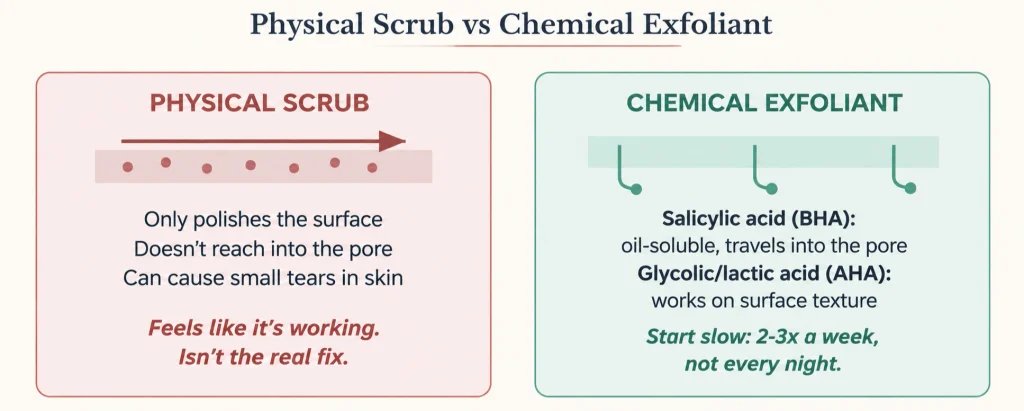
Salicylic Acid vs Glycolic Acid
This is where skincare advice can get confusing because both ingredients exfoliate, but they aren’t identical.
Salicylic acid is especially relevant when pore congestion, blackheads, or comedonal acne are the main concern. Glycolic acid is an alpha hydroxy acid, or AHA, used for exfoliation and texture. It isn’t useless for comedonal skin concerns: DermNet lists both salicylic acid and glycolic acid among topical options for comedonal acne.
But if your main question is specifically how to unclog pores, salicylic acid is usually the more directly relevant ingredient to understand first.
Where Retinoids Fit
Retinoids are another evidence-supported option for comedonal acne. The American Academy of Dermatology recommends retinoids for unclogging pores and notes that they can help treat blackheads and whiteheads.
That doesn’t mean everyone with a few visible pores needs a retinoid. But for persistent blackheads or closed comedones, retinoids are worth understanding rather than treating them simply as a “stronger exfoliant.”
If you’re pregnant or trying to become pregnant, avoid retinoids and speak with your obstetrician or dermatologist about appropriate alternatives. The AAD’s pregnancy skin-care guidance advises avoiding topical retinoids during pregnancy.
Moisturizer Still Belongs in the Routine
Trying to remove every trace of oil can make a clogged-pore routine unnecessarily harsh.
Moisturizer is especially useful if an active such as salicylic acid or a retinoid leaves your skin dry or irritated. Keeping your skin comfortable can make an active routine easier to tolerate. If you’re prone to clogged pores, a lightweight, non-comedogenic moisturizer may be a practical choice.
If you’re unsure where treatments, moisturizer, and sunscreen belong, our skincare routine order guide walks through the correct sequence.
What Actually Does What?
| Ingredient or step | Role | TBT take |
| Salicylic acid | Targets clogged pores and comedonal acne | CORE when congestion is the main issue |
| Retinoid | Helps clear pores and treat blackheads/whiteheads | CORE option for persistent comedonal acne |
| Glycolic acid | Exfoliation and texture | USEFUL, but a different job from salicylic acid |
| Gentle cleanser + moisturizer | Supports a tolerable routine | SUPPORT |
| Clay mask or pore strip | Mostly temporary cosmetic/surface effect | OPTIONAL |
| Harsh scrubs or repeated squeezing | Can irritate or damage skin | USE CAUTION / SKIP aggressive use |
| Steam to ‘open’ pores | Does not literally open pores like doors | MYTH to avoid |
What About Pore Strips, Scrubs, Clay Masks and Steam?
Pore strips are satisfying because you can see material on the strip afterward. But removing visible material is not the same as preventing another clogged pore from forming. Cleveland Clinic also cautions that pore strips can remove sebaceous filaments, which are normal parts of the skin.
Clay masks can temporarily absorb surface oil, which may make oily skin feel fresher. They still don’t replace a consistent routine for recurring comedonal acne.
Steam is another common pore-care tip. Warmth may make the skin feel softer, but pores don’t need to be “steamed open” before they can be cleaned.
Scrubbing deserves even more caution. The AAD recommends gentle cleansing and avoiding scrubbing acne-prone skin because irritation can make acne harder to manage.
These methods aren’t all equally useful, and some can irritate skin when used aggressively or too often.
If your routine leaves you with persistent burning, stinging, redness, tightness, or peeling, don’t assume that means it is “working.” It may be a sign that your routine has become too aggressive.
Why Do My Pores Keep Getting Clogged Again?
Unclogging pores is one thing. Keeping them clear is another.
Oil production continues. Skin cells continue shedding. And if your skin is prone to comedones, removing one visible plug doesn’t stop another from developing later.
That’s why repeatedly squeezing, extracting, or stripping the same area can become a cycle.
Sebaceous filaments make this even clearer. Cleveland Clinic explains that sebaceous filaments are normal and can refill after squeezing. So you can make them temporarily less noticeable without permanently eliminating them.
For actual comedonal acne, prevention and maintenance matter more than chasing every individual pore. Consistency is usually less exciting than extraction. It’s also far more useful.
Can You Actually Shrink Your Pores?
Not permanently in the way skincare advertising sometimes suggests. Pores aren’t doors that repeatedly open and close. Their visibility can change, though.
When congestion is making pores look more noticeable, keeping them clearer may improve their appearance. Oiliness, skin texture, sun damage, and changes in skin firmness can also affect how noticeable pores look. The AAD’s guidance on making pores look less noticeable focuses on reducing clogging, irritation, and sun damage rather than promising permanent pore closure.
So the realistic goal isn’t to “close” every pore. It’s healthier-looking skin with less visible congestion.
A Simple Routine for Clogged Pores
Morning: gentle cleansing as needed → appropriate treatment if you use one → moisturizer → sunscreen.
Night: remove makeup and sunscreen as needed → gentle cleanse → chosen treatment → moisturizer.
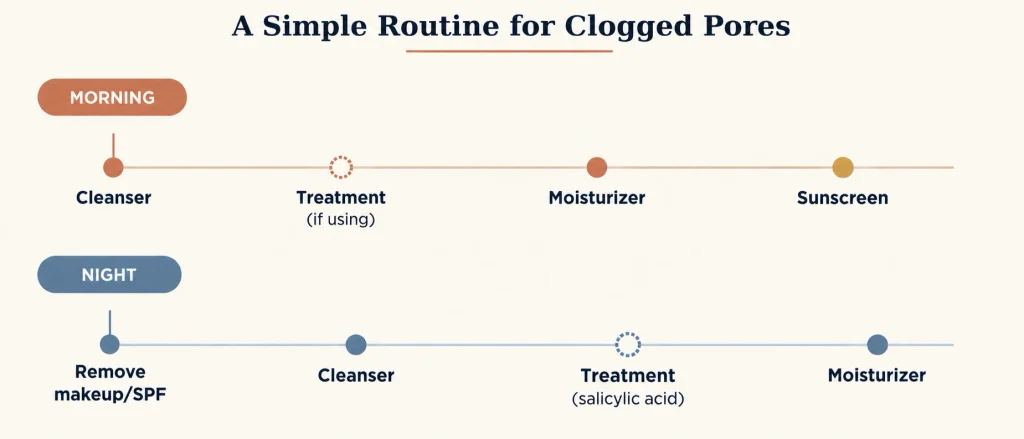
The important part is not adding salicylic acid, glycolic acid, a retinoid, a scrub, a clay mask, and a pore strip all at once. Choose the treatment that makes sense for the problem and give it time.
The American Academy of Dermatology advises giving blackhead and whitehead treatment about six to eight weeks to work. That isn’t a promise that every clogged pore will disappear in eight weeks. It’s a reminder not to abandon or replace a sensible routine every few days.
When You Should Stop Treating It Yourself
A few blackheads are very different from deep, painful, inflamed, or scarring acne.
If your breakouts are painful, leaving scars, becoming significantly inflamed, or simply aren’t improving despite consistent appropriate care, it’s time to speak with a dermatologist. The AAD recommends dermatologist care for deeper acne such as nodules and cysts because these lesions can scar.
The same applies if you’re not sure whether the bumps are acne at all. Sometimes the smartest pore treatment is knowing when to stop experimenting.
The Bottom Line
The real answer to how to unclog pores isn’t stronger cleansing or constantly trying to empty them.
First, figure out what you’re actually seeing. A blackhead, a closed comedone, a sebaceous filament, and a naturally visible pore don’t need exactly the same response.
Then keep things simple. Cleanse gently. Choose an appropriate treatment. Protect your skin from unnecessary irritation. And give the routine enough time to work.
Your pores don’t need punishment. They need the right approach and a little consistency.
Pingback: Fall Skincare Routine: What to Change as Weather Cools
Pingback: : Acne Skincare Routine: What to Use & What to Skip
Pingback: How to Get Glass Skin: A Simple Step-by-Step Routine
Pingback: CeraVe Cream vs Lotion: Which Is Right for Your Skin?
Pingback: Everything Shower Routine: The Ultimate Guide, Step by Step
Pingback: CeraVe SA Cleanser Review: Is It Worth Buying?