
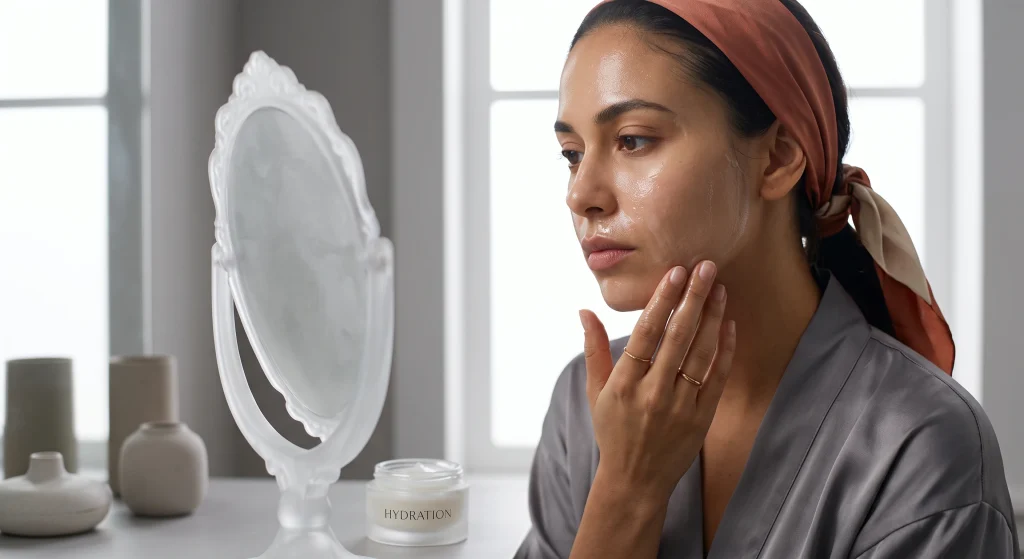
You apply moisturizer expecting your skin to look softer and fresher. Instead, your face suddenly looks a little darker, flatter, or strangely greasy. Or it looks fine at first, then dull an hour later. If you are asking why does my moisturizer make my skin look dull, the moisturizer is not automatically “bad.” The timing, amount, texture, hydration level, skin barrier, and the products underneath it can all change the final look.
The first thing to work out is what “dull” means on your skin. Is it slightly deeper in color right after application? Shiny but not fresh? Tight and rough underneath the shine? Or are darker patches staying for days? Those are different problems, and they need different fixes.
We have noticed this with moisturizers too: a formula can feel fine when it first goes on, then leave the skin looking heavier and oilier later. That is why judging a moisturizer only in the first minute can be misleading.
Table of Contents
First, Is It Dullness, Darkness, or Just Shine?
These words get mixed together, but they are not the same.
- Dullness: Skin looks flat, muted, rough, or less radiant.
- Shine: Oil or product on the surface reflects light. Shiny skin can still look dull underneath.
- Temporary darker-looking finish: Skin may look slightly deeper immediately after moisturizer because hydration and the product film change the way light interacts with the surface.
- Pigmentation: Color changes remain in the skin instead of disappearing as the product settles or washes off.
A clinical study on the appearance effects of skin moisturization found that as skin became more moisturized, surface light scattering and spectral reflectance decreased while translucency increased. In that experiment, moisturized skin could look darker, pinker, and more translucent. That is an optical change – not proof that a moisturizer created new pigment in a few minutes.
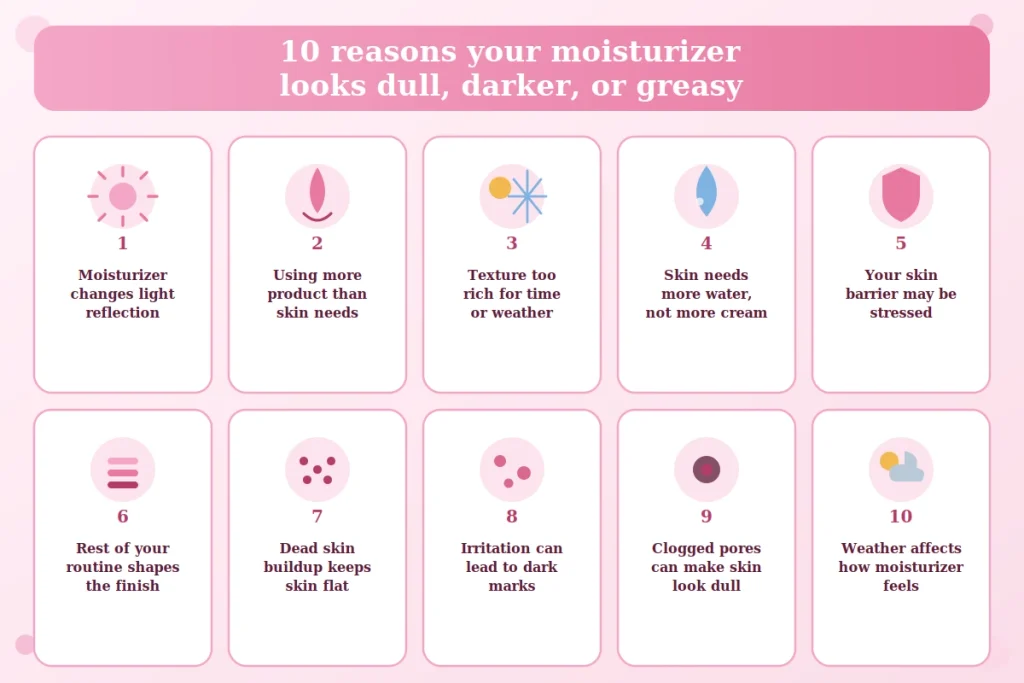
. Why Does My Moisturizer Make My Skin Look Dull? 10 Possible Reasons
1. The Moisturizer Changes How Light Reflects From Your Skin
Freshly moisturized skin does not reflect light exactly like dry skin. Water in the outer layer plus the product sitting on top can change the surface enough that your face looks a little deeper, more translucent, or more reflective for a while. If the change happens immediately, your skin feels comfortable, and the color looks normal again later, this is very different from true darkening that stays.
2. You May Be Using More Product Than Your Skin Needs
A thick layer can leave a visible film. Then your natural oil starts mixing with it. Thirty minutes later, the finish may look heavy rather than fresh. This is especially noticeable with rich creams, facial oils, silicone-heavy layers, or several hydrating steps underneath.
Before replacing the product, try a smaller amount for a few days. Use the same lighting when you compare the result. If your skin looks dull after moisturizer but improves when you use less, quantity was probably part of the problem.
3. The Texture May Be Too Rich for the Time, Weather, or Routine
A cream that feels perfect at night can feel too coated under sunscreen in the morning. The same product can also behave differently in hot, humid weather than it does in a dry winter. Skin type matters, but so do climate, season, the products underneath, and what you put on top.
This does not mean everyone with oily skin needs a gel or everyone with dry skin needs a thick cream. Texture is a starting point, not a rule. The better question is whether your skin feels comfortable and whether the finish stays balanced after the full routine settles.
4. Your Skin May Need More Water – Not Simply a Heavier Cream
People often use “dehydrated skin” to describe skin that is low in water. It can happen even when the surface is oily. That is why skin can look shiny but still feel tight, rough, or strangely flat.
A useful clue is comfort. Does your skin feel tight after cleansing? Do fine lines look more obvious when the skin feels dry? Does makeup catch on rough areas even though your face becomes oily later? If yes, adding an even richer cream may not be the whole answer.
Modern moisturizers can contain several kinds of ingredients. DermNet explains that formulas may combine humectants, emollients, and occlusives. Humectants such as glycerin attract and bind water. Emollients help smooth the outer surface. Occlusives reduce water loss by forming a more protective layer. So the goal is not automatically “serum first, cream second.” Look at what your moisturizer already contains and how your skin responds.
5. Your Skin Barrier May Be Stressed
The outermost layer of skin helps keep water in and outside irritants out. When that barrier is not functioning well, skin may lose water more easily and feel rough, tight, flaky, stingy, or unusually reactive. That uneven surface can also look less smooth and radiant.
A review of skin-barrier function and moisturization describes how humectants, emollients, and occlusives can support the physical barrier in different ways. Moisturizers are therefore more than a cosmetic “seal,” but the exact formula matters.
Do not assume dull skin automatically means a “damaged barrier.” Dullness alone is not enough. Barrier stress becomes more plausible when dullness comes with tightness, roughness, flaking, burning, stinging, redness, or sudden sensitivity to products that were previously comfortable.
6. The Rest of Your Routine May Be Creating the Finish
Sometimes the moisturizer gets blamed because it is one of the last steps. But toner, essence, two serums, facial oil, moisturizer, and sunscreen can create a very different finish than the moisturizer does on bare skin.
If you are not sure what should go where, simplify for a few days and check skincare routine order. Change one variable at a time. That makes it much easier to see whether the moisturizer is really the problem.
7. Dead Skin Buildup Can Make Moisturized Skin Still Look Flat
Moisturizer can soften a rough surface, but it does not automatically solve every cause of uneven texture. When the outer surface is rough or flaky, light reflects less evenly, so skin can still look dull even when it feels softer.
But this is where a lot of dull-skin advice goes too far. Do not jump straight to a scrub or strong acid just because you want more glow.
The American Academy of Dermatology’s exfoliation guidance warns that exfoliation can irritate skin when it is too aggressive or poorly matched to the person. If your skin is already burning, stinging, red, or very sensitive, adding more exfoliation can make things worse.
8. Clogged Pores Can Make Your Skin Look Dull Too
When oil, dead skin cells, and other buildup collect inside pores, your skin can start to look uneven or less clear. You may notice small bumps, blackheads, or whiteheads along with the dullness. In this case, changing your moisturizer may not solve the whole problem.
If clogged pores are part of what you are seeing, our guide on how to unclog pores explains what actually helps without being too harsh on your skin.
9. Weather Can Make Your Moisturizer Feel Different on Your Skin
A moisturizer you love in cool weather may feel completely different on a hot, humid day. A lighter daytime texture in warm weather and something richer when skin feels dry in colder weather can be a practical adjustment.
That does not mean your skin type has completely changed. It means your skin’s needs and the way a formula feels can shift with the environment.
10. Irritation Can Turn a Temporary Problem Into Persistent Dark Marks
An immediate slightly darker-looking finish is not the same as pigmentation. But irritation is worth taking seriously, especially if your skin is prone to dark marks.
The American Academy of Dermatology notes that irritating skin-care products can contribute to dark spots in darker skin tones. If a moisturizer repeatedly burns, stings, itches, causes redness, or seems to leave lasting darker areas, stop treating it like a simple cosmetic-finish problem.
The Timing Test: When Does the Dullness Appear?
Timing cannot diagnose your skin, but it is one of the most useful clues.
| What you notice | When it appears | What to check first | What to try |
| Slightly deeper, but comfortable | Immediately | Optical effect, product finish | Wait 10-15 minutes; compare in the same natural light |
| Shiny, heavy, or flat | 30-60 minutes | Amount, rich texture, layering, natural oil | Use less; simplify the layers underneath |
| Oily-looking but tight | Any time | Low water content, stripping cleanser, barrier stress | Use a gentler routine; review humectants and moisturizer formula |
| Stinging, burning, itching, redness | Minutes to hours | Irritation or sensitivity | Stop the suspect product and simplify |
| Dark areas remain | Days or weeks | Irritation, pigmentation, or another cause | Do not treat as a temporary finish; consider dermatology advice |
How to Tell If Hydration or Your Skin Barrier Is the Bigger Issue
Instead of asking only whether your moisturizer is “glowy,” look at how your skin behaves between applications.
- Your face feels tight soon after cleansing.
- Skin looks oily on top but does not feel soft or comfortable.
- You see roughness, flaking, or makeup catching on dry patches.
- Products that used to feel fine suddenly sting.
- You recently increased acids, retinoids, scrubs, acne treatments, or cleansing.
- Cold weather, low humidity, air conditioning, or frequent hot washing has made your skin feel different.
If several of these sound familiar, focus first on comfort and a simple routine rather than chasing instant brightness. A gentle cleanser, a moisturizer that suits your skin, and daily sunscreen are a better base than adding multiple new actives at once.
The AAD recommends applying moisturizer while skin is still damp after washing for dry skin, and choosing gentle, fragrance-free products when dryness or sensitivity is an issue. See the dermatologist guidance here.
What to Try Before You Replace Your Moisturizer
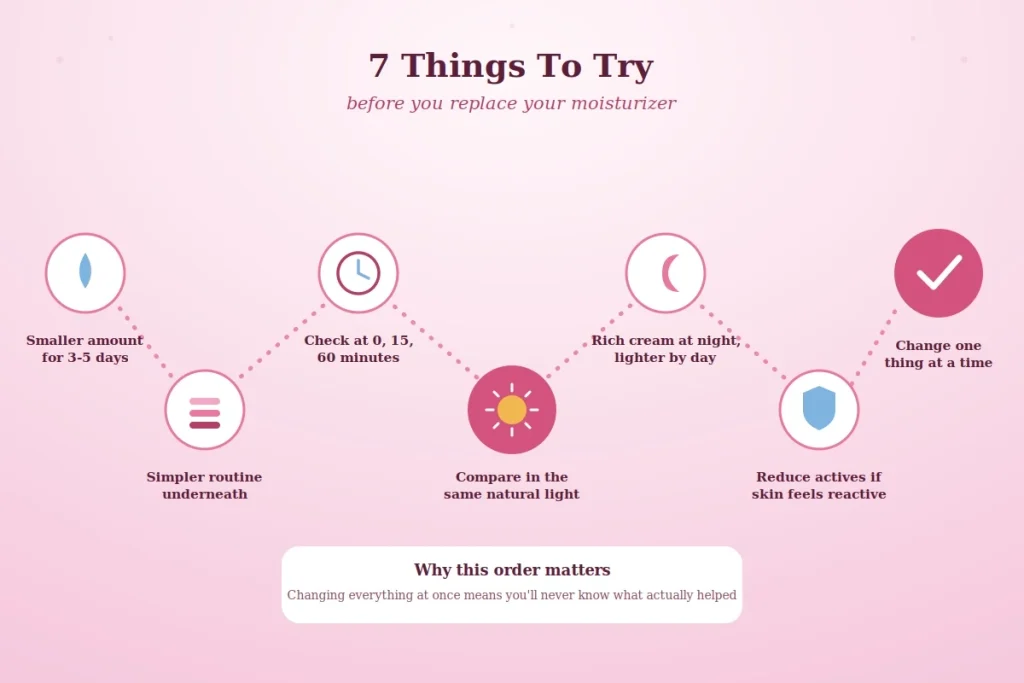
- If you keep wondering “why does my moisturizer make my skin look dull,” start by using a smaller amount for three to five days.
- Try the moisturizer over a simpler routine instead of several serums and oils.
- Check your skin immediately, after 15 minutes, and again around an hour later.
- Compare in the same natural light. Bathroom lighting can exaggerate shine and shadows.
- If daytime feels heavy, try the rich moisturizer at night and a lighter texture in the morning.
- If skin feels tight or reactive, reduce irritating or unnecessary actives instead of adding more exfoliation.
- Change only one thing at a time. Otherwise you will not know what actually helped.
Which Moisturizer Texture Is Best for Your Skin Type?
There is no perfect texture for every face, but these are reasonable starting points:
| Skin pattern | Texture to consider | Watch for |
| Oily or easily shiny | Light gel-cream or lotion | Tightness underneath the shine; formulas that feel sticky or coated |
| Dry or flaky | Lotion, cream, or richer cream | A heavy film that still does not relieve tightness |
| Combination | Light lotion overall; more only where needed | Greasy T-zone with dry cheeks |
| Sensitive or reactive | Simple, gentle, fragrance-free option | Burning, stinging, itching, redness |
| Acne-prone | Lightweight, non-comedogenic option | Repeated congestion or irritation |
A future TBT guide will compare gel vs cream moisturizers in more detail. Until then, judge the formula by comfort, finish, climate, and how it behaves with the rest of your routine – not by texture name alone.
When You Should Stop Blaming the Moisturizer
Dullness can also come from uneven texture, existing pigmentation, sun exposure, irritation from another product, makeup, sunscreen finish, or simply how the skin looked before moisturizer went on. If the problem is already there before application, changing moisturizer may improve the finish without fixing the real cause.
And if a darker area lasts for days or weeks, or your skin is persistently itchy, painful, swollen, burning, or unusually sensitive, it is worth getting professional advice rather than continuing to experiment.
FAQ
Why does my skin look dull after applying moisturizer?
It can make skin look temporarily different. Hydration and the product film can change how light scatters and reflects from the surface. That is not the same as creating new pigment within minutes.
Why does my moisturizer make my skin dull and oily at the same time?
Because shine and glow are not the same thing. A rich texture, too much product, natural oil, or several layers can create surface shine while the complexion still looks flat underneath.
Can oily skin be dehydrated?
Yes. Oil and water are different. Skin can produce plenty of oil while the outer layer still has low water content or feels tight and uncomfortable.
Does dull skin mean my skin barrier is damaged?
No. Dullness alone does not diagnose barrier damage. Barrier stress is more likely when dullness comes with tightness, roughness, flaking, stinging, burning, redness, or increased sensitivity.
Should I exfoliate if moisturizer makes my skin look dull?
Not automatically. Exfoliation may help if rough surface buildup is part of the problem, but it can worsen irritation if your skin is already sensitive or over-treated.
Should I stop using a moisturizer that makes me look dull?
Not immediately if your skin feels comfortable. First test a smaller amount, a simpler routine, and a different time of day. Stop the product if it repeatedly causes burning, stinging, itching, swelling, or persistent irritation.
Is a gel moisturizer always better for oily skin?
No. It can be a useful starting point, but formula matters more than the label. Some gels can still feel sticky, and some light lotions work very well for oily skin.
The Bottom Line
If you keep wondering why does my moisturizer make my skin look dull, do not judge the product by “glow” alone. Look at when the change appears, whether your skin feels comfortable, how much product you used, what is underneath it, and whether the change disappears after the routine settles.
An immediate slightly darker-looking finish can be temporary. A heavy or greasy look later may point to amount, texture, or layering. Tightness and roughness bring hydration and barrier support into the conversation. Burning, stinging, or dark areas that stay deserve a different level of attention.
The goal is not to force your skin to look shiny. It is to find a routine that leaves it comfortable, smooth, and balanced – then let the glow be the side effect.
Pingback: Fall Skincare Routine: What to Change as Weather Cools
Pingback: How to Get Glass Skin: A Simple Step-by-Step Routine