
You wash your face the same way you did all summer. But now your skin feels tight afterwards.
Maybe it looks a little dull. Maybe your usual moisturizer suddenly does not feel like enough.
That is often when a fall skincare routine needs a few small adjustments.
As temperatures drop and the air becomes drier, products that felt comfortable in summer may not feel quite right anymore. But that does not mean you need an entirely new routine for autumn.
When my own skin gets dry, tight and more sensitive as the weather changes, I usually change one or two things. I switch to a gentler cleanser and use a richer moisturizer. When my skin needs extra comfort, I sometimes apply a second layer.
The short answer? Don’t rebuild your routine for fall. Adjust the steps that no longer work for your skin.
In this Article
Why Your Skin Can Feel Different When Fall Arrives
As the weather gets cooler and the air becomes drier, your skin may have a harder time holding on to moisture. Cold weather and dry indoor environments can contribute to dry skin.
Indoor heating can add to the dryness too.
That is why your fall skincare routine may need a few adjustments as you move from warm summer weather into cooler autumn days.
A lightweight moisturizer that worked perfectly in summer, for example, may suddenly feel too light. Your skin may also start feeling rough, flaky, itchy or uncomfortable.
But seasonal change does not automatically mean you need new products.
Summer-to-Fall Skincare: What Actually Needs to Change?
Moving from a summer to fall skincare routine is less about adding more products and more about watching how your skin responds.
During summer, you may prefer lightweight gels, foaming cleansers and thinner layers. As fall arrives, some of those products may still work perfectly well. Others may start leaving your skin tight or uncomfortable.
Before changing anything, ask yourself:
- Does my cleanser leave my skin tight after washing?
- Does my moisturizer wear off too quickly?
- Has my skin become flaky or rough?
- Are exfoliating acids or retinoids suddenly harder to tolerate?
- Does my sunscreen still feel comfortable?
If nothing has changed, you do not need to change your routine just because it is autumn.
First, Don’t Change Everything
If your routine still feels good, keep it.
A change in the calendar is not enough reason to change your skincare. Your skin should guide that decision.
Some people notice dryness as soon as autumn arrives. Others may not notice much difference at all.
Before buying anything, ask yourself:
- Does my skin feel tighter, rougher or drier than usual?
- Does my current routine still leave my skin comfortable?
- Is something that worked before suddenly feeling too drying?
If your skin still feels good, you may not need to do anything. If it does feel different, start small.
Swap #1: Make Your Cleanser Gentler If Washing Leaves You Tight
Your cleanser is a good place to start.
Pay attention to how your skin feels immediately after cleansing. If it regularly feels tight, dry or uncomfortable after washing, your current cleansing routine may be too drying for your skin right now.
That tight feeling is not something you need to chase for a “clean” face.
When the weather changes and my own skin becomes very dry and sensitive, this is one of the first things I change. I switch to a gentler cleanser.
Look for a cleanser that leaves your skin feeling comfortable after washing. If your skin is dry or easily irritated, a gentle, fragrance-free option may be worth considering.
You do not need a product with “fall” or “winter” written on the bottle. You simply need something that works for your skin.
Use warm water instead of very hot water, and apply moisturizer while your skin is still slightly damp after washing. These are small changes, but they can make a dry-skin routine feel more comfortable.
If clogged pores are also a concern, read our How to Unclog Pores the Right Way guide before reaching for stronger cleansers or scrubs.
Swap #2: Try a Richer Moisturizer If Yours No Longer Feels Enough
If your cleanser already feels gentle but your skin is still dry, the next step in your fall skincare routine is to look at your moisturizer.
Maybe your summer moisturizer used to keep your skin comfortable. Now your skin starts feeling dry again much sooner. That can be a sign that you need more moisture.
In simple terms:
- Gels usually feel light and absorb quickly.
- Lotions are also fairly light.
- Creams are usually thicker and richer.
- Ointments are much heavier and can be useful for very dry areas.
You do not automatically need the heaviest option. If your current moisturizer no longer feels comfortable, you can try a richer texture and see how your skin responds.
This is another change I make myself. When my skin becomes drier as the weather changes, I move to a thicker moisturizer.
The goal is not to use the richest cream you can find. The goal is to find a texture that keeps your skin comfortable.
Ingredients such as glycerin, hyaluronic acid and ceramides can be useful in moisturizing formulas. But do not choose a moisturizer only because one popular ingredient appears on the label. The whole formula matters.
And if your skin is already dry or sensitive, a fragrance-free product may be a better choice.
If your moisturizer hydrates your skin but leaves your face looking flat, heavy or greasy later, our guide to why moisturizer can make skin look dull explains what may actually be happening.
What About Applying a Second Layer?
Sometimes my skin still feels like it needs a little more comfort. On those days, I sometimes apply a second layer of moisturizer.
This is something I personally do. It is not a rule that everyone needs to follow.
If one layer keeps your skin comfortable, there is no reason to add another. If two layers feel heavy or uncomfortable, go back to one. More product is not always better.
Swap #3: Be More Careful With Anything Already Making You Dry
When skin starts looking rough or flaky, it can be tempting to scrub the flakes away. But this is not the time to become more aggressive.
When your skin already feels dry or irritated, strong scrubbing or using too many exfoliating products can make it feel worse.
This may be a good time to look at the steps that already have the potential to dry or irritate your skin. You may decide to use an exfoliating product less often. If retinol is part of your routine, you may also need to pay closer attention to how often you use it as your skin becomes drier. If you’re new to retinol, our Best Retinol Serums for Beginners guide can help you choose a beginner-friendly option.
The aim is not to remove every active from your autumn skincare routine. It is to pay attention to what your skin can comfortably tolerate.
If you are unsure where treatments, exfoliants and moisturizer belong, see our Skincare Routine Order guide before adding more steps.
If a dermatologist or doctor has prescribed a treatment, do not stop or change it because of an article. Ask them what to do if the treatment is causing dryness or irritation.
And if a product repeatedly causes burning, strong stinging or significant redness, stop guessing and get appropriate professional advice.
Keep This Step: Sunscreen
One thing should not disappear from your routine just because summer has ended: sunscreen.
UV exposure does not disappear when the weather becomes cooler. Keep protecting exposed skin throughout the year.
A broad-spectrum, water-resistant sunscreen with SPF 30 or higher is a good general standard to follow.
If the sunscreen you loved in summer starts feeling too drying, consider a more moisturizing formula. Change the texture if you need to. Do not remove the protection.
This matters even more if you are trying to fade pigmentation, because sun exposure can make discoloration harder to manage. Our Dark Spots on Face guide explains how sun protection fits into a dark-spot routine.
Quick Fall Skincare Tips
If you do not want to overhaul your routine, start here:
- Keep products that still feel comfortable.
- Switch cleansers if washing leaves your skin tight.
- Move to a richer moisturizer only if you need it.
- Avoid very hot water.
- Be cautious about increasing exfoliation when your skin is already dry.
- Keep wearing sunscreen.
- Introduce one change at a time so you can tell what actually helps.
Your fall skincare routine should respond to your skin, not to a seasonal shopping list.
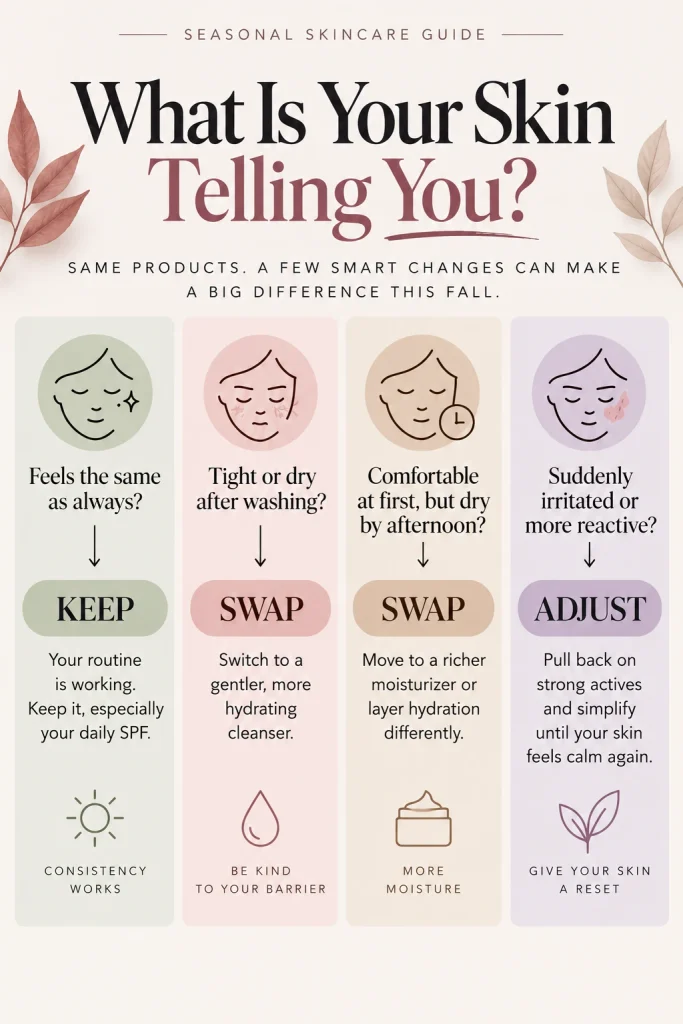
The TBT Keep, Swap or Adjust Fall Skin Check
Change something because your skin needs it, not because the calendar tells you to.
A Simple Morning Fall Skincare Routine
Your fall routine does not need ten steps. A simple morning routine can be:
- Cleanse gently, if needed.
- Apply any treatment or serum you already use and tolerate.
- Apply moisturizer.
- Finish with sunscreen.
Not sure which product goes before which? Our Skincare Routine Order guide breaks down the basic AM and PM order.
Your own routine may include other products. That is fine. The point is not to follow an exact number of steps. It is to keep the basics gentle and comfortable when your skin feels drier.
A Simple Night Fall Skincare Routine
Night can be just as simple:
- Cleanse.
- Use your treatment step if you have one and your skin is tolerating it well.
- Apply moisturizer.
On nights when my own skin feels particularly dry, this is where I may use that second layer of moisturizer. Again, that is my personal habit. It is not something every reader needs to add.
Fall-to-Winter Skincare Transition: When Should You Adjust Again?
Your routine may need another small adjustment as late fall turns into winter. Do not wait for a specific date. Watch your skin.
If colder weather or indoor heating starts leaving your skin tighter, flakier or more uncomfortable, reassess the same three areas: cleanser, moisturizer and potentially irritating actives.
You might need a richer moisturizer than you used in early fall, or you may need to use an exfoliating treatment less frequently.
But if your fall skincare routine is still keeping your skin comfortable as winter approaches, there is no reason to change it again.
Keep what works. Adjust what does not.
When It May Be More Than Normal Seasonal Dryness
Mild dryness may improve after you make simple changes to your routine. But not every skin problem should be treated as normal seasonal dryness.
If your skin becomes very painful, badly cracked, bleeding, extremely itchy or stays very dry despite your efforts, consider getting professional medical advice.
Persistent dry skin can sometimes need proper diagnosis and treatment. A skincare article cannot tell you what is causing a medical skin problem.
Sometimes getting the right professional advice is much more useful than continuing to change products on your own.
Final Takeaway: Change What Your Skin Needs, Not Everything You Own
Fall does not require a skincare shopping spree.
Your fall skincare routine may only need one or two small changes.
Switch to a gentler cleanser if washing leaves your skin feeling tight.
Try a richer moisturizer if your usual one no longer feels like enough.
Be more careful with products that are already making your skin feel dry or irritated.
And keep your sunscreen.
But there is one more option that matters just as much:
If your skin still feels good, do nothing.
Listen to your skin.
Keep what is working.
Swap what is not.
And adjust only when you need to.
Pingback: Skincare Routine Order: What Goes First & What You Need
Pingback: Dark Spots on Face: Causes, Types & How to Fade Them