

If your skincare shelf is full of acids, retinol and serums, but you are never quite sure what to use on which night, a skin cycling routine can make things much simpler.
The basic idea is easy: Night 1 is for exfoliation, Night 2 is for a retinoid, and Nights 3 and 4 are for recovery. Then you repeat the cycle.
The goal is not to use more skincare. It is actually the opposite. Skin cycling gives stronger ingredients their own nights and builds recovery time into your routine.
But here is the part that matters: your skin does not have to follow the calendar perfectly. If it feels dry or irritated, you can add another recovery night.
On this Page
Skin Cycling Routine at a Glance
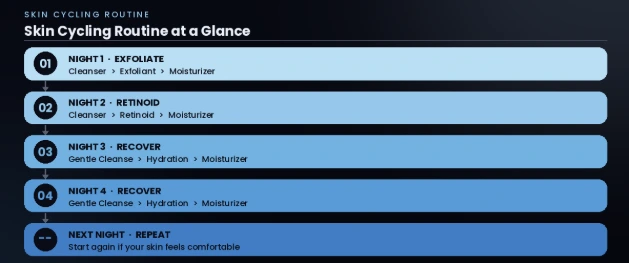
Morning: Keep things simple. Cleanse or rinse as needed, moisturize and finish with sunscreen.
What Is Skin Cycling and Why Do People Do It?
Skin cycling is a way of organizing active skincare ingredients across different nights instead of using everything at once.
Think of it as a schedule for your nighttime skincare.
Rather than exfoliating, applying retinol and adding several other treatments in one routine, you give the stronger ingredients separate nights. Recovery nights come in between before the cycle starts again.
Why do people like it?
Because skincare can get complicated very quickly.
One bottle says exfoliate. Another says use retinol. Then there is vitamin C, niacinamide, azelaic acid and whatever new serum just appeared on your feed.
A skin cycling routine gives those products some structure. It may also help some people avoid overusing strong actives.
That does not mean the four-night method is proven to be better than every other skincare routine. Ingredients such as retinoids have established uses in dermatology, but skin cycling itself is best thought of as an organizational framework, not a magic treatment.
What Do You Need for Skin Cycling?
- A gentle cleanser
- A chemical exfoliant
- A retinoid
- A moisturizer
- Sunscreen for daytime
That is enough to build the classic cycle.
If you are confused about where your other products fit, our Skincare Routine Order: What Goes First and Why guide can help you sort out the basic order without turning your bathroom shelf into a chemistry experiment.
Night 1 — Exfoliation
Start with cleansing. Then apply your exfoliant according to its directions and finish with moisturizer.
The American Academy of Dermatology explains that chemical exfoliation can use ingredients such as alpha-hydroxy acids and beta-hydroxy acids. It also warns that over-exfoliating can leave skin red and irritated.
In other words, Night 1 is exfoliation night, not “use every acid I own” night.
AHA or BHA: Which Should You Choose?
You do not need both just because both exist.
AHA can make more sense when rough, dry or dull-looking surface texture is your main concern.
BHA, such as salicylic acid, can be useful when oil, blackheads and clogged pores are the bigger problem.
If congestion is what you are trying to fix, our CeraVe SA Cleanser review explains how salicylic acid fits into a pore-focused routine. You can also see our glass skin routine for a simple explanation of AHA, BHA and over-exfoliation.
Sensitive or reactive skin needs more caution. Do not assume that everyone needs a strong acid.
Also skip the urge to add a harsh scrub on top. More exfoliation does not automatically mean smoother skin.
Night 2 — Retinoid
The second night of a skin cycling routine is usually the retinoid night.
The simple order is: Cleanser → Retinoid → Moisturizer
Retinol is one type of retinoid. Prescription retinoids also exist, so follow the directions for the specific product or medication you use rather than treating every retinoid the same.
If you are completely new to this ingredient, our Complete Acne Skincare Routine explains how retinoids such as adapalene can fit around a simple cleanser and moisturizer without stacking too many actives.
The AAD recommends starting retinoids cautiously, because jumping straight into a strong formula or using it too often can cause irritation.
Moisturizer can also help make retinoid use easier to tolerate.
And remember: burning and peeling are not trophies. Irritation does not prove that your retinoid is working better.
Nights 3 and 4 — Recovery
Now your routine gets boring.
That is a good thing.
Recovery nights give you a break from the stronger actives used on Nights 1 and 2.
A simple routine can be: Gentle cleanse → Hydration → Moisturizer
Recovery does not mean doing nothing. It means focusing on comfort and moisture instead of trying to treat another concern.
Ingredients such as glycerin, hyaluronic acid, ceramides and squalane can fit well here depending on the products your skin already tolerates.
You do not need all four.
If your moisturizer already gives your skin enough hydration, use it and go to bed. Your recovery night does not need its own seven-step routine.
How to Adjust the Skin Cycling Routine for Your Skin
Here is where we would stop treating skin cycling like a strict calendar.
The classic four-night pattern is a starting point, not a rule your face has agreed to follow.
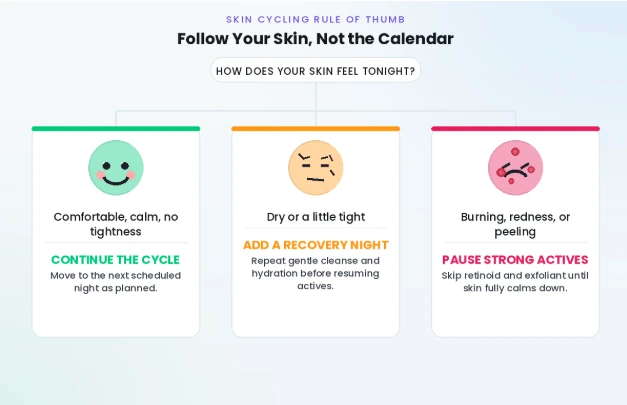
When to Add More Recovery Nights
Comfortable and normal? Continue to the next scheduled night.
A little dry or tight? Consider adding another recovery night.
Burning, very red or significantly peeling? Pause irritating actives and simplify the routine.
The irritation keeps returning? Stop forcing the cycle and consider getting professional advice.
A skin cycling routine should make active use easier to manage, not turn skincare into an endurance test.
What About Different Skin Types?
Dry skin may need more recovery and gentler exfoliation.
Oily skin does not automatically need more acids. You can have oily skin and still over-exfoliate it.
Sensitive skin may need slower introduction of actives or a different routine altogether.
Combination skin can also be flexible. Your cheeks and T-zone do not always behave the same way.
If acne or recurring breakouts are driving your active choices, our Hormonal Acne Skincare Routine explains how to choose an active for a clear reason instead of adding everything at once.
The 4-Night Cycle Does Not Have to Match a 7-Day Week
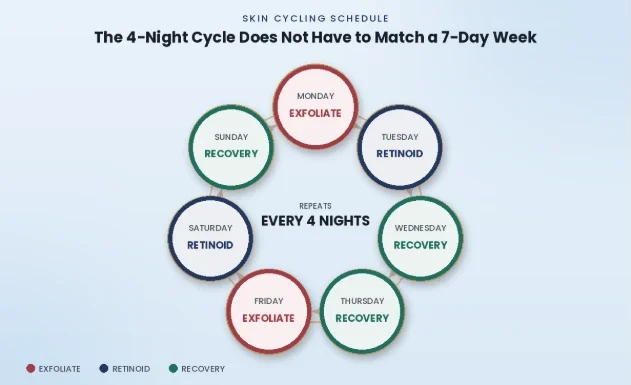
Notice what happened? Monday changed. You do not restart the cycle every Monday. Just continue to the next night in your cycle.
What About Your Morning Routine and Other Serums?
Skin cycling mainly organizes your nighttime actives. Your morning routine can stay simple.
Try: Cleanse or rinse → Optional serum → Moisturizer → Sunscreen
Daily sun protection is especially important when retinoids are part of your routine. The AAD also advises sun protection when using retinoids.
What about all your other serums?
Hyaluronic acid and niacinamide can often work as supportive ingredients. Peptides may also fit into a simple routine. Vitamin C is commonly used in the morning.
If vitamin C is part of your routine, our Best Vitamin C Serums for Dark Spots guide also explains why starting several strong actives together can make irritation harder to manage.
Azelaic acid is a little different because it can be an active treatment in its own right. If you use it for acne or pigmentation, think about your whole routine rather than automatically squeezing it into an already busy night.
The main rule is simple: You do not need to fit every serum you own into your skin cycling routine.
Signs Your Skin Cycling Routine Is Too Much
- Persistent burning or stinging
- Redness that does not settle
- Increasing tightness
- Significant peeling or flaking
- New sensitivity
- Products that normally feel fine suddenly stinging
The AAD notes that exfoliation can worsen dryness and irritation when combined with products that already make skin more sensitive, including retinoids.
Irritation can also matter if you are prone to dark marks. Our Best Vitamin C Serums for Dark Spots guide explains why irritation can work against a pigmentation-focused routine.
So if your skin is clearly unhappy, adding another active is usually not the answer.
Common Skin Cycling Mistakes
- Using several acids on exfoliation night
- Adding a harsh scrub to chemical exfoliation
- Using too much retinoid
- Starting strong actives too quickly
- Thinking irritation means a product is working
- Skipping moisturizer because your skin is oily
- Forgetting daytime sunscreen
- Adding too many extra serums
- Forcing the schedule when your skin feels irritated
- Constantly switching products
- Assuming everyone needs exactly the same four-night cycle
If acne is driving most of your active choices, our Complete Acne Skincare Routine explains how to treat breakouts without making every step an acne treatment.
Who Should Be More Careful With Skin Cycling?
A standard skin cycling routine will not suit everyone exactly as written.
Be more careful if you have very reactive skin, rosacea, eczema, psoriasis or significant inflammatory acne.
The same applies if you already follow a treatment plan from a dermatologist. Do not replace prescribed treatment with a four-night routine you saw online.
Pregnancy also changes the conversation because the classic cycle includes a retinoid.
The AAD advises avoiding retinoids during pregnancy. If you are pregnant or trying to become pregnant, discuss your skincare and medications with your healthcare professional rather than simply following the standard retinoid night.
How Long Does Skin Cycling Take to Work?
There is no honest one-size-fits-all timeline.
Your skin may feel more comfortable fairly quickly if you stop overloading it with actives. But acne, clogged pores, pigmentation, texture and fine lines do not all change at the same speed.
The treatment matters too.
Do not judge your entire skin cycling routine by whether your face looks transformed after one four-night cycle.
Consistency matters, but so does using the right treatment for the concern you actually have.
If your goal is smoother, more hydrated-looking skin rather than treating a specific condition, our How to Get Glass Skin guide explains why hydration, barrier support and realistic timelines matter too.
Is Skin Cycling Actually Better Than a Normal Routine?
Not necessarily.
This may be the most important thing to understand about skin cycling.
It can be useful if your current routine feels confusing, you keep stacking strong ingredients, or you want a simple way to separate exfoliation and retinoid use.
But if you already have a simple routine that works well and your skin tolerates it, you do not need to change everything because skin cycling is popular.
You also do not have to follow a skin cycling routine forever.
Your tolerance can change. Weather can change. Your treatment goals can change. You may eventually need more or fewer recovery nights.
The routine should work for your skin—not the other way around.
Skin Cycling Routine FAQs
Is skin cycling good for beginners?
It can be. The clear schedule may make exfoliants and retinoids easier to organize. Beginners should still introduce strong ingredients cautiously rather than assuming the four-night schedule guarantees they will not get irritated.
Can I skin cycle without retinol?
Yes. You can adapt the idea of alternating treatment and recovery nights even if retinol is not appropriate for you. It simply will not be the classic four-night version.
Can I use niacinamide or hyaluronic acid every night?
They can often fit into several nights because they are not being used as the main exfoliating or retinoid step. What matters is whether the complete formula suits your skin.
Can I use vitamin C while skin cycling?
Yes, depending on your skin and product. Morning use can keep it separate from the main nighttime cycle. Do not force it into your routine if the combination leaves your skin irritated.
What happens if I miss a night?
Nothing dramatic. Continue from where you left off. You do not need to restart the whole cycle.
Can I skin cycle if I have acne?
Possibly, but acne treatment should come first. A generic four-night schedule may not match the frequency recommended for your acne medication or treatment.
Should I exfoliate and use retinol on the same night?
The classic skin cycling method separates them. This can make the routine easier to tolerate for beginners. People with established routines may use actives differently, but there is no need to combine them just to make the routine stronger.
Do I have to follow exactly four nights?
No. That is the whole point of listening to your skin. Add recovery nights when you need them rather than forcing your skin to keep up with a calendar.
The Bottom Line
A skin cycling routine can make active skincare much easier to understand: exfoliate, use your retinoid, recover, recover, then repeat.
But the smartest part of the routine is not the number four.
It is learning when to use an active and when to leave your skin alone.
Start simple, use sunscreen, pay attention to irritation and add recovery time when you need it. If your skin is already happy with another routine, you do not need to change it just to follow a trend.