

Vitamin c serum advantages sound impressive when you read a serum box, but the useful question is simpler: what will vitamin C actually change on your skin? Someone can start a new serum expecting brighter skin in a week, then feel disappointed when a dark spot is still there. Vitamin C does not work like an instant filter. Its value is in steady, realistic changes with consistent use.
Quick answer: The main vitamin c serum advantages are antioxidant support, a brighter and more even-looking tone, help with the appearance of dark spots, and support for collagen. It can also work alongside sunscreen to help defend skin from oxidative stress. It cannot replace SPF, erase deep wrinkles, or remove stubborn pigmentation overnight. If dark spots are your main concern, our vitamin C serums for dark spots guide can help you choose a product after you understand what the ingredient can realistically do.
In this Article
Vitamin C Serum Advantages at a Glance
The vitamin c serum advantages that matter most are antioxidant support, help with excess pigmentation and support for collagen. Harvard Health notes that topical vitamin C may improve wrinkles and dark spots.
It is most useful for dullness, uneven tone, early fine lines, dark marks or extra antioxidant support. It is an added treatment step; sunscreen and a comfortable basic routine still matter more.
- Can: support brighter, more even-looking skin.
- Can: help reduce the appearance of some dark spots over time.
- Can: add antioxidant support to a morning routine.
- Cannot: replace broad-spectrum sunscreen.
- Cannot: erase deep wrinkles or stubborn pigmentation overnight.
What Vitamin C Serum Can Actually Do for Your Skin
The best way to understand vitamin c serum advantages is to connect each claim to a visible skin concern. Some benefits are better supported than others, and the formula matters. Here are the changes that are most reasonable to expect.
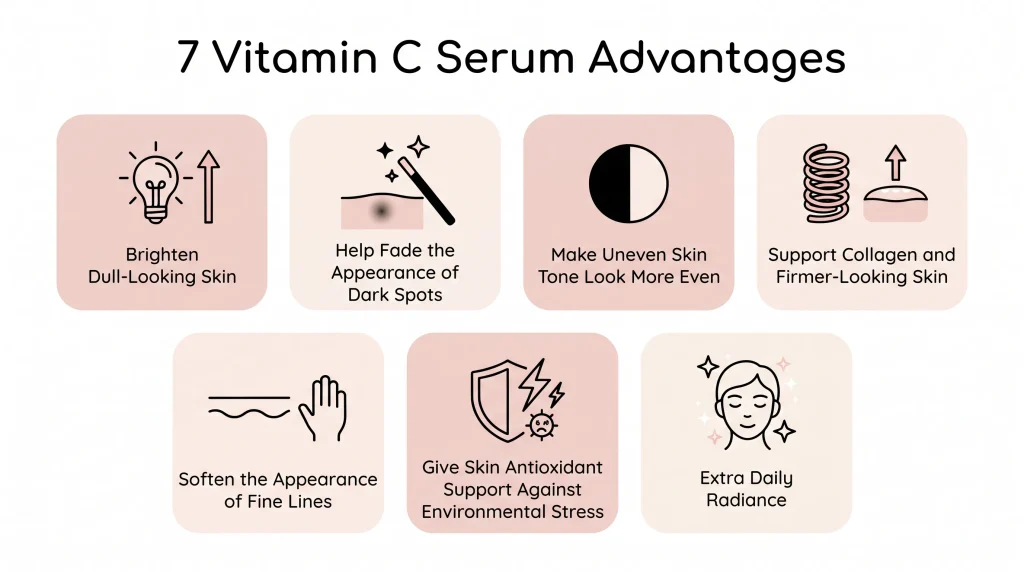
1. Brighten Dull-Looking Skin
Vitamin C can make dull skin look fresher by helping with oxidative stress and excess pigment. “Brightening” does not mean bleaching your natural skin tone. It means a clearer, more even-looking finish over time.
2. Help Fade the Appearance of Dark Spots
One of the most useful vitamin c serum advantages is support for uneven pigmentation. Vitamin C can affect pigment formation, which is why it is used for post-acne marks and sun-related discoloration. Harvard Health reports improvement in dark spots in clinical trials, while noting that more research is needed. Our dark spots on the face guide explains why these marks form.
3. Make Uneven Skin Tone Look More Even
Small areas of discoloration can make the whole complexion look patchy. By helping with excess pigment and oxidative stress, vitamin C may gradually make skin look more balanced without changing its natural color.
4. Support Collagen and Firmer-Looking Skin
Vitamin C is involved in collagen production, which matters because collagen gives skin structure. Regular topical use may support smoother, firmer-looking skin, but it is not an instant tightening treatment.
5. Soften the Appearance of Fine Lines
Collagen support also explains why fine lines appear among vitamin c serum advantages. Harvard Health cites research where daily vitamin C use for at least three months improved facial and neck wrinkles. Results still depend on the formula, consistency and your skin.
6. Give Skin Antioxidant Support Against Environmental Stress
UV exposure, pollution and normal body processes can create free radicals. Antioxidants help neutralize them. This is a key role of vitamin C, but antioxidant support is not the same as blocking UV rays.
What Vitamin C Serum Cannot Do
A realistic look at vitamin c serum advantages needs limits. Vitamin C cannot replace sunscreen or guarantee that melasma, old post-acne marks or deep wrinkles will disappear. A “vitamin C” label also does not guarantee an effective formula.
More is not automatically better. Cleveland Clinic notes that vitamin C can cause dryness, itching or redness and advises a lower L-ascorbic acid concentration for sensitive skin. A comfortable formula is easier to use consistently.
Vitamin C and Sunscreen: What Extra Protection Really Means
This is where vitamin c serum advantages are often overstated. Vitamin C provides antioxidant support, while sunscreen protects against UV radiation. Harvard Health says vitamin C may add protection when used with broad-spectrum sunscreen. The two have different jobs.
So do not count a vitamin C serum as SPF. Apply your serum first, then moisturizer if you need it, and finish with sunscreen. If the order still feels confusing, our moisturizer or sunscreen first guide explains the last steps clearly.
- Antioxidant support
- Helps with oxidative stress
- Can support a brighter, more even look
- UV protection
- Helps prevent sun damage
- Stays the essential daytime protection step
How Long Until You Actually See a Difference?
The vitamin c serum advantages are usually gradual. Do not judge a new serum after a few mornings. Harvard Health says noticeable improvement may take up to three months of consistent use. Cleveland Clinic gives a similar three-month expectation. That is a useful benchmark, not a promise that every concern will clear by a fixed date.
Take a photo in the same lighting before you start and compare later. Watch overall brightness, dark marks and fine lines instead of checking daily. See a dermatologist if pigmentation is worsening or its cause is unclear.
Does the Type of Vitamin C Change the Benefits?
Yes. Vitamin c serum advantages depend partly on the formula. L-ascorbic acid has substantial research behind it, but it can be difficult to formulate and may irritate some skin.
Magnesium ascorbyl phosphate is a stabilized vitamin C derivative used in topical products and studied for skin delivery and pigment-related applications. It is not identical to every other form. The practical point here is to judge the full formula and your skin’s tolerance rather than chasing one ingredient name.
Who Is Most Likely to Benefit From Vitamin C Serum?
The vitamin c serum advantages make the most sense if your goals include dull-looking skin, uneven tone, visible dark marks, early fine lines or extra antioxidant support during the day. You do not need all of these concerns to use it. One clear reason is enough.
For dark spots, vitamin C can be one part of a broader routine rather than the only treatment. If your skin is already irritated or overloaded with strong actives, make the routine comfortable before adding another serum.
How to Use Vitamin C Without Making Your Routine Complicated
You do not need a long routine to get the vitamin c serum advantages. In the morning, cleanse if needed, apply vitamin C, follow with moisturizer when your skin needs it, then use sunscreen. Our skincare routine order guide shows where common products fit without turning the routine into ten steps.
Follow the product directions and your skin’s tolerance. If daily use feels uncomfortable, start less often. Avoid adding several strong new actives together because it becomes harder to identify the cause of irritation.
- Cleanse as needed.
- Apply vitamin C serum.
- Moisturize if needed.
- Finish with sunscreen.
- Cleanse gently.
- Use your usual treatment if your skin tolerates it.
- Moisturize to support comfort.
When Vitamin C May Not Be Right for Your Skin
Not everyone gets the vitamin c serum advantages without irritation. Dryness, itching or redness can happen, especially with stronger acidic formulas. If your skin burns, becomes persistently red or develops a rash, stop using the product rather than trying to force your skin to adjust.
Sensitive skin may do better with a gentler approach and fewer active products at once. If you already struggle with reactions, our sensitive skin guide can help you build the basics first. Seek medical advice for a severe reaction or for pigmentation that changes quickly or has an uncertain cause.
- Start simply: add vitamin C to an otherwise familiar routine.
- Watch comfort: mild tingling can happen, but persistent burning is not a goal.
- Stay consistent: give a tolerated formula time to work.
- Keep SPF: daytime sun protection remains essential.
FAQs
What are the main vitamin C serum advantages?
The main vitamin c serum advantages are antioxidant support, brighter and more even-looking skin, help with the appearance of dark spots, and support for collagen. Results are gradual, and sunscreen is still essential.
Does vitamin C serum really brighten skin?
It can. Vitamin C may help reduce excess pigment formation and oxidative stress, which can make dull or uneven-looking skin appear brighter over time. It does not bleach your natural skin tone.
Can vitamin C serum fade dark spots?
Vitamin C can help improve the appearance of some dark spots, especially when used consistently with good sun protection. Stubborn pigmentation may need other treatments or advice from a dermatologist.
Can I use vitamin C serum every day?
Many people can use it daily if the formula suits their skin. If you develop dryness, stinging or redness, reduce use or stop and reassess the product.
Should I use vitamin C serum in the morning or at night?
Either can be possible, but morning use is popular because its antioxidant role complements sunscreen. Apply sunscreen afterward. Follow the directions for your specific serum.
Is magnesium ascorbyl phosphate good for skin?
Magnesium ascorbyl phosphate is a stabilized vitamin C derivative used in skincare. It has been studied for topical antioxidant and pigment-related effects, but the performance of a product still depends on its full formulation.
Bottom Line
The most useful vitamin c serum advantages are not instant transformation. Vitamin C can support brighter, more even-looking skin, help with visible dark spots, support collagen and add antioxidant protection to a good routine. It works best when expectations are realistic and sunscreen stays non-negotiable. If those benefits match your goal, choose a formula your skin can tolerate and give it consistent time before deciding whether it earns a place in your routine.