
Okay, so everyone asks this: serum or moisturizer first? Here’s the answer. Serum goes first, then moisturizer. That’s it. That one rule is right for most people, most days.
Now the fun part. A few things can mess with the order. Oil serums, retinol, vitamin C and acids all have their own little moods. And what your skin actually needs depends on your skin type. Don’t worry, I’ve got all of it for you below.
Here’s what to do. Wash your face and put your serum on. Then wait about a minute and let it sink in. Put your moisturizer on top to hold it all in. In the morning, sunscreen goes last. Not sure about that last step? Our guide on moisturizer or sunscreen first has the full story.
Keep reading. I’ll show you the exceptions in one quick table, a morning and night routine, and a simple guide for your skin type.
The Short Answer on Serum or Moisturizer First
Skincare goes from thinnest to thickest. Serums are light and watery, so they go on first and sink in. Moisturizers are thicker, so they go on top and seal everything in. Cleveland Clinic gives the same order: cleanser, serum, moisturizer, then sunscreen in the morning.
The American Academy of Dermatology (AAD) agrees on the idea. It says to wash your face, apply any treatment right after cleansing, then moisturizer and sunscreen. It also warns that the order affects how well your products work.
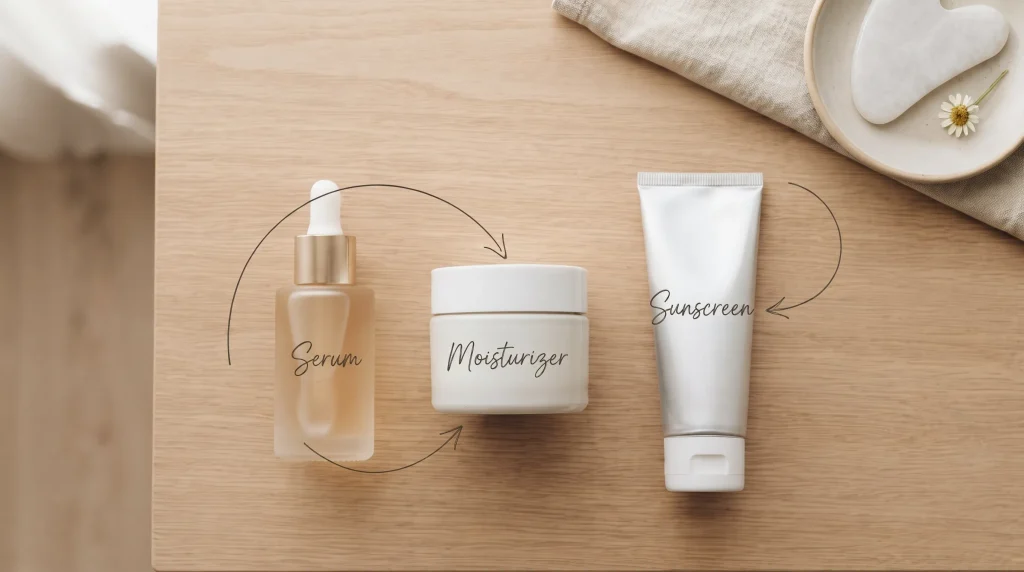
- Step 1: cleanse your face and pat it dry.
- Step 2: apply serum and wait 30 to 60 seconds.
- Step 3: apply moisturizer on top.
- Step 4: in the morning, finish with sunscreen.
- Exception: oil based serums and face oils go after moisturizer.
What Is a Serum, and What Is a Moisturizer?
Before you decide on serum or moisturizer first, it helps to know what each one does. A serum is a light, concentrated product made to deliver one active ingredient, such as vitamin C for dull skin, niacinamide for oil and redness, or hyaluronic acid for water. Most serums are water based and feel thin.
A moisturizer is a richer product that softens skin and slows water loss. It usually contains humectants that hold water, such as glycerin, and emollients that smooth the surface. Gel creams are light, lotions are in the middle, and creams are rich.
Some products blur the line. Rich serums exist, and so do very light moisturizers. So when you are unsure about serum or moisturizer first, go by texture, not by the name on the bottle: the thinner product goes first.
Why Serum or Moisturizer First Matters
When you ask serum or moisturizer first, you are really asking which product gets to your skin. A serum is made to carry active ingredients such as vitamin C, niacinamide or hyaluronic acid. If a thick cream goes on first, it can sit between the serum and your skin, and the serum has less chance to do its job.
A moisturizer has a different job. It holds water in and softens the skin barrier. That is why you should not skip it after a serum, because a water based serum can evaporate and leave skin feeling dry.
More products are not better. The AAD warns that too many products, especially several anti aging ones, can irritate skin. If your routine feels long, start with our acne skincare routine guide and cut it back.
When Serum or Moisturizer First Changes
The rule is a guide, not a law. The order changes when the product is not a thin, watery serum. Here is how each type fits.
| Product | Where it goes | Why |
|---|---|---|
| Water based serum (hyaluronic acid, niacinamide) | Before moisturizer | Light, so it sinks in first |
| Vitamin C serum | Morning, before moisturizer | Works as a serum and supports sunscreen |
| Retinol or retinoid | Night, before moisturizer | Pea size amount, and moisturizer can calm dryness |
| Exfoliating acids | Right after cleansing, then moisturizer | Used a few nights a week, not daily |
| Oil based serum or face oil | After moisturizer, or in place of it | Oil is heavy, so it seals the layers below |
| Sunscreen | Last in the morning | It must sit on top to protect |
Two sources disagree a little. Cleveland Clinic suggests one serum, used in the morning, and retinol at night in its place. Others use a serum morning and night. Start with one product and add another only when your skin is happy.
If your skin is sensitive to retinol, you can put moisturizer first, then retinol, then more moisturizer. Our gentle retinol cream guide has gentler options, and how to exfoliate your face explains how often to use acids.
Morning and Night Order
- Cleanse or rinse with water
- Vitamin C or hydrating serum
- Moisturizer
- Sunscreen, SPF 30 or higher
- Cleanse once, gently
- Retinol or a repair serum, one at a time
- Moisturizer, or a richer cream
- No sunscreen needed
For serum or moisturizer first at night, the same rule holds: serum, then moisturizer. Cleveland Clinic says to cleanse only once, since double cleansing does more harm than good. If you wear sunscreen or heavy makeup, use a cleanser that removes it in one wash.
Serum or Moisturizer First by Skin Type
The answer to serum or moisturizer first stays the same for every skin type. What changes is how much you use and what you choose.
- Dry skin: use a hydrating serum, then a rich moisturizer, and never skip the cream. Niacinamide can also help restore the skin barrier. A face oil can go on last at night. See moisturizers for very dry skin.
- Oily skin: a light gel or water serum is enough. In hot weather, many people with oily skin can use a very light moisturizer, or skip it over a serum that already hydrates.
- Acne prone skin: pick water based, non comedogenic products. Dermatologists quoted by The Zoe Report suggest salicylic acid serums for breakouts. Our non comedogenic moisturizer guide shows what to look for.
- Sensitive skin: use one serum at a time, patch test it, and add the next product after two weeks.
- Mature skin: vitamin C in the morning and retinol at night are the classic pair, each followed by moisturizer.
How Much to Use and How Long to Wait
Getting the amount right matters as much as serum or moisturizer first. Too much serum can feel sticky and pill under your cream, and too little moisturizer leaves skin tight.
- Serum: a few drops, or about a pea size, for the whole face.
- Moisturizer: a coin size amount, or enough to cover your face and neck.
- Retinol: a pea size amount, as Cleveland Clinic advises.
- Wait 30 to 60 seconds between layers, until skin feels settled and not wet.
- Wait about 15 minutes after an oil based serum before sunscreen.
Always follow the directions on your bottle. Some actives, like strong acids, need their own timing.
Common Mistakes With Serum and Moisturizer
Most problems come from the order or from using too much, not from the products themselves. Check this list if your skin feels sticky, dry or irritated.
- Using a moisturizer first and a serum on top, so the serum cannot reach your skin
- Skipping moisturizer after a serum, which can leave skin dry
- Using several serums at once, which can irritate skin
- Rushing from one product to the next with no pause
- Treating an oil as a serum and putting it in the wrong step
- Using hyaluronic acid in a dry climate with no moisturizer over it, which can pull water out of your skin
Do You Always Need Both a Serum and a Moisturizer?
Not always. When people ask serum or moisturizer first, many forget that a serum is optional. At a minimum, Cleveland Clinic says to use a cleanser, then moisturizer, then sunscreen. A serum is a bonus that targets one goal, such as dark spots or dryness. If your serum is rich, or your skin is oily in summer, you may be fine with the serum alone at some times of year.
In winter, always use a moisturizer over a water based serum, because cold, dry air takes moisture from your skin.
FAQs
Do you put serum or moisturizer first?
For most people, the answer to serum or moisturizer first is serum first. Apply it to clean skin, wait about a minute, then use moisturizer on top.
Does serum go before or after moisturizer?
Before. The only common exception is an oil based serum or face oil, which usually goes after moisturizer or takes its place.
Can I use serum and moisturizer together?
Yes. Using serum and moisturiser together is the usual routine. The serum delivers the active ingredient and the moisturizer seals it in. Just keep the order thin to thick.
Should serum first or moisturiser first change at night?
No. The order is the same at night. Use retinol or a repair serum, then moisturizer. Many people use a richer cream at night.
Do I need to wait between serum and moisturizer?
Wait 30 to 60 seconds, or until your skin feels settled and not wet. For an oil based serum, wait longer before sunscreen.
What if I only have time for one step?
Use moisturizer and sunscreen in the morning, and moisturizer at night. Add a serum later when you have a specific goal, like dryness or dark spots.
Bottom Line
When you wonder about serum or moisturizer first, remember the rule: thin to thick. Serum first, moisturizer second, sunscreen last in the morning. Add one product at a time, and read the label of anything with an active ingredient. If you are not sure about a step, check the AAD order guide or ask a dermatologist. Want a serum that fits? See our niacinamide serum review.